Showing posts with label anne-of-cleves. Show all posts

Saturday, 6 April 2013

Was Anne of Cleves really a Flander's Mare?

Ever since Henry VIII discarded Anne of Cleves on the grounds that he thought she looked more like a "Flander's Mare" than the pretty portrait by Holbein, it has been believed for centuries that the German princess was very unattractive. So unattractive in fact that the King could not bring himself to consummate their marriage. But is it true - was Anne really that ugly? Let's take a look:

The English diplomat Christopher Mont was at the German courts and was thus able to hear a thing or two about the appearance of Anne of Cleves (her brother had still not allowed the English lords to look at his sisters). Christopher never actually saw Anne herself but he reports that:

Everyman praiseth the beauty of the said Lady, as well for the face, as for the whole body. She excellelth as far the Duchess of Milan as the golden sun excelleth the silver moon.
Another contemporary - and possibly more reliant source - was the French ambassador at the English court Charles de Marillac. Since it was not a French princess he had no reason to be inclined to lie about what he saw. After seeing Anne he said that she looked to be around 30 years old (she was actually just 24) as well as tall and thin. He wrote that she was:
Of middling beauty with a determined and resolute countenance. 
He went on to comment that she was not as beautiful as people had claimed her to be (mirroring the thoughts of Henry VIII) and continued with:
There is a steadiness of purpose in her face to counteract her want of beauty 
Henry VIII had been completely taken in by the portrait of Anne by Holbein and there is a good reason for that. Holbein was infamous for his ability to depict people exactly as they looked without the flattering that normally was applied when dealing with aristocratic people. Actually this was why Henry had sent Holbein to  paint her - he wanted to be sure that he got what he saw. Several accounts states that Holbein had actually succeeded in cathcing Anne of Cleves' image in his portrait and if that is the case it can be difficult to see why she was thought to be ugly.

Holbein's portrait of Anne -
it shows a rather pretty and
young woman
There is another contributor to this "ugly image" that has clung to Anne of Cleves for centuries now: her clothes. The German fashion that Anne wore when she arrived in England was anything but flattering - compared to the elegant French fashion and the cosier English fashion it was downright clumsy.
After the divorce of the German princess and the English King descriptions of Anne of Cleves paints a picture of a woman who is not unpleasant to look at - it has to be stated that these accounts probably are more correct since it was no longer necessary to flatter the ex-Queen. When Henry decided to marry Catherine Parr it has been noted that Anne of Cleves was irritated by the fact that her former throne was being taken over by a woman "less attractive than herself". Since no one contradicted her it might have been true.

Recent discoveries have shown that Holbein actually changed Anne's nose in her portrait. X-rays of the portrait reveals that she originally was portrayed with a longer nose but even at that it was not larger than normal - it matches the length of Jane Seymour.

Finally there is the matter of her skin complexion. One of the things that apparently threw Henry most off was the fact that she was a lot "darker" in her complexion than what he had been informed. The long journey across the English channel had damaged her fine complexion - or that was at least what the courtiers could come up with.
So there is nothing that suggests that Anne of Cleves was terribly ugly. It is more likely that she was indeed a "middling beauty" that is not ugly but not extremely beautiful either.

Monday, 25 March 2013

Queens' Rings


All can be bought here


A Palace of Queens

Yet another post of Hampton Court Palace! Some of the famous six wives of Henry VIII have left their mark on this favourite palace of their husband. So, let's take a look at the reminders of Queens that has been long lost to history.

This is the ceiling of the Anne Boleyn
Gateway - the squares that surronds
the Tudor rose involves Anne's falcon
The Anne Boleyn Gateway is now named after the doomed second wife of Henry VIII but it was not the case at the time - imagine the weirdness of that! After the downfall of Anne Boleyn, Henry VIII wanted to erase every memory of her and had her badges and initials removed. But a few were forgotten and today they serve as a reminder of the Queen that Henry wanted to forget. Anne's badges can still be seen at the Anne Boleyn Gateway which is also where the gateway derives its name. Also, her falcons and initials still adorns the great hammer-beams of the Great Hall's ceiling.

Jane Seymour's badge can be seen on an original frieze outside the Royal Chapel. Also the Great Watching Chamber still house references to this third wife. A phoenix rising from a castle can be seen on the ceiling of this room - the very badge of Jane.

Anne of Cleves is - despite her very short marriage - also among the wives that the castle can tell us about. In what is now a tea room a plate is displayed. This plate shows signs that it belonged to Edward VI - but the wheel of Cleves can still be seen on it. It is likely that the plate was hastily changed after the annulment of the couple's marriage.

Even Catherine of Aragon's pomegranate still remains - it hangs above a door frame, apparently forgotten.


Katherine Howard's ghost has put the "haunted" in the Haunted Gallery but since it is not a physical artifact I have chosen not to include it here.

Wednesday, 20 March 2013

The Tudors & Baths

Well, we all know that the hygiene was lacking (to say the least) at the court of the Tudors. But it appears from recently discovered documents that the Tudors bathed and washed more than we have thought so far. So, let's take a look at some of the Tudors - who were the clean ones and who skipped their baths?

But strangely enough, Henry VIII defied the health advises from the doctors and bathed! At Hampton Court Palace (Bayne Tower) he had a large tub installed which was the height of what technology could do: it was heated by a stove in the room next door and the hot water was led from there to the King's tub. Henry's wound his leg was constantly aching and the King chose to bathe in a mixture of herbs and musk - attempting to ease the pain.
The King even went so far as to take herbal baths - except when the sweating sickness was out.

Mary, Queen of Scots was also fond of bathing. According to rumours the Scottish Queen liked to bathe in wine!

Also Elizabeth I bathed frequently compared to her courtiers. It is reported that the Queen bathed at least once every month - and to her contemporaries that was almost too much! The Queen's sharpened sense of smell might have contributed to the frequent baths but Elizabeth still joins the league of the "clean" Tudors!

But of course, not everyone followed these royal examples as you can see from the following examples:

Anne of Cleves followed German traditions and hardly ever bathed. When she was engaged to Henry VIII her advisers allegedly had to work hard on convincing Anne that she had to bathe before she met the King.

Besides Henry VIII's bath tub at Hampton Court, the royal family also had access to bath tubs at the Tower and Windsor Castle. Henry VIII actually built yet another bathroom at Whitehall at the end of the 1540's.
Other courtiers would buy soap and scented water to clean their hands and douche their bodies. The very wealthy could even afford perfume to sprinkle on the body in an attempt to get rid off the smell.

Sunday, 24 February 2013

German Fashion

When Anne of Cleves arrived at the English court, her clothes made an unfortunate impression on the English courtiers. Anne, being German, naturally wore the German fashion but this was far from popular with the English ladies. Let's take a look at what the German fashion actually looked like:

Wednesday, 20 February 2013

A Life Changing Portrait


This is the infamous portrait that would convince Henry VIII to marry Anne of Cleves. Hans Holbein was sent to Cleves to paint a likeness of the sisters Anne and Amelia of Cleves. When he returned the King adored the portrait of Anne of Cleves and consequently chose her as his fourth wife. But the King's adoration turned to disgust when she arrived for their wedding where he immediately proclaimed that he "liked her not" and that she looked like a horse.
If we are to judge by this picture - not regarding whether Holbein beautified it or not - Anne of Cleves was definitely not ugly - personally I think she is rather beautiful and looks like a very sweet person.

Wednesday, 13 February 2013

Remainder of a Short Reign


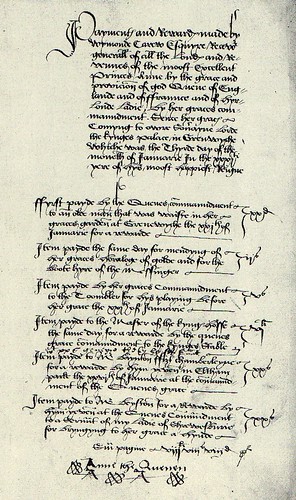
This is a rare document from the very short reign of Anne of Cleves as Queen of England. It carries her signature, Anne the Quenen. Few documents like this has survived due to the shortness of Anne's reign which meant that she simply did not have enough time to use her new powerful signature.

Drawings of the Queens

I have come across these beautiful drawings of Henry VIII's wives and I thought that I might share them (I have arranged them to look nicer):


Badge of the German Princess


Anne of Cleves' badge is very different from Henry VIII's previous three wives in colour and form. The escarbuncle (the main feature of her badge) is a symbol sovereignty or a precious gemstone. Her badge was not as packed with symbols as the other Queen's had been - in fact the only unique feature of any meaning other than the escarbuncle, is the colour: gold.
Gold symbolised not only the luxury colour that we associate it with but both generosity and enlightenment. But - as we know - Anne's badge spent a minimum space of time on the walls of the royal palaces.  

Saturday, 9 February 2013

Anne of Cleves

Anne of Cleves was born in 1515 in Düsseldorf and was the daughter of John III, thus making her of the House of La Marck. When she was twelve Anne was betrothed to Francis of Lorraine who was heir to the dukedom of Lorraine. But Francis was only ten at the time and the betrothal was cancelled in 1535. But Anne was not to be a spinster.
Thomas Cromwell was eager to have Henry VIII marry into the Protestant League in Germany because it would provide him with protection against the Catholic countries of Spain and France who were signing a treaty. Henry (superficial as always) was not happy about having to marry someone he had never seen and demanded that the court painter Hans Holbein was to go to Germany and paint the likeness of Anne of Cleves. And he liked what he saw.