Showing posts with label artefacts. Show all posts

Monday, 12 August 2013

Romantic Henry

Purse; crimson velvet; in the shape of a powder flask, with stiffened centre padded with horsehair; a drawstring pouch on each side and silver braid round edge.
This red velvet purse was given by Henry VIII to "Anne Bullyne". The purse is in the shape of a flask but its exact purpose is unknown. Its centre has been stiffened with horsehair.
Silver braiding adorns the edge of the purse and it is opened by a drawstring pouch. Perhaps it was used for coins?

Saturday, 29 June 2013

Jousting Rules

This document was written on 12 February 1511 for a joust given by Henry VIII as a celebration for the birth of a son to the young King and Catherine of Aragon. The latter is even mentioned in the document as "Queen Noble Renown"  who was there when the tournament took place. She had sent four knights by the nicknames of "Ceure Loyall" (Sir Loyal), "Vailliaunt Desyre" (Valiant Desire), Bone Voloyor and "Joyous Panser" - the men behind these amusing nicknames were in fact Henry VIII himself (remember that he called himself "Sir Loyal Heart"), Sir Thomas Knyvet, Lord William Courtenay and Sir Edward Neville. The list also names several other courtiers who signed up for the challenge.

The tournament itself had all the typical grandiose luxury of Henry VIII. The fighting knights would arrive to the jousting place disguised as a moving forest with a castle of golden paper! Recordings from the Great Wardrobe shows that extravagant costumes were ordered. But the prince for whom this was all arranged would be dead by 10 days.

Wednesday, 5 June 2013

An Early Memory

Even though this cross may not have a direct connection to a specific Tudor, it has witnessed the start of it all: the Battle of Bosworth Field. It was found as late as 1778 on Bosworth Field itself. The cross is made of gilded bronze and has been decorated with a "sunburst symbol" which was a badge of the York-family - this makes it quite possible that it was carried by Richard's supporters. The four circles bears the symbols of the four Evangelists: an eagle (St. John), a winged man (St. Matthew), the winged lion (St. Mark) and the winged ox (St. Luke).
The cross was found alongside the remains of a wooden shaft which indicates that it has been carried on procession - it must have been lost or forgotten since it was still at Bosworth Field three hundred years after the battle itself.

A Subtle Hint ..

These pieces were made by Mary, Queen of Scots and has a very symbolic meaning: the cat - or "catte" - represents her cousin Elizabeth I whereas Mary herself is the mouse. It is believed that Mary created this while she was her cousin's prisoner. This is one of the many pieces that Mary either sew or embroidered that has survived to the present day.

Portrait Miniature


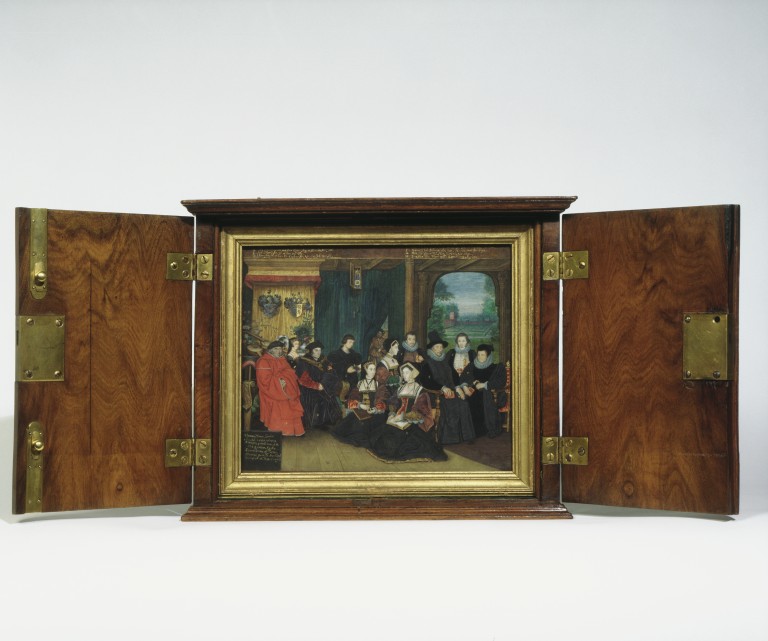
It is Thomas More and his family that is the motive for this miniature. The portrait is not contemporary since there are four generations present in this portrait and the family members did not live at the same time. The cabinet is made from walnut and the portrait has been painted on vellum by Rowland Lockey between 1593-94. Of course, by then Thomas More himself was long dead, so Lockey used Hans Holbein's portrait of the disgraced Chancellor.

The Howard Grace Cup

The Howard Grace Cup was made in London between 1525-26. The bowl is made from elephant ivory and the rest is gilded gold and silver adorned with pearls and gemstones. A grace cup was normally used when giving thanks for a meal. The gold mount is dated between 1525-1526 but it is possible that the ivory bowl was from the 12th century. It has been in the Howard family's possession since 1614 - hence "the Howard Grace Cup".
The style is a mixture between Tudor-style and the Gothic. Several Latin inscriptions can be found on the cup including: "Be Sober", "Fear God" and "Drink Thy Wine With Joy".

The Dudley Box

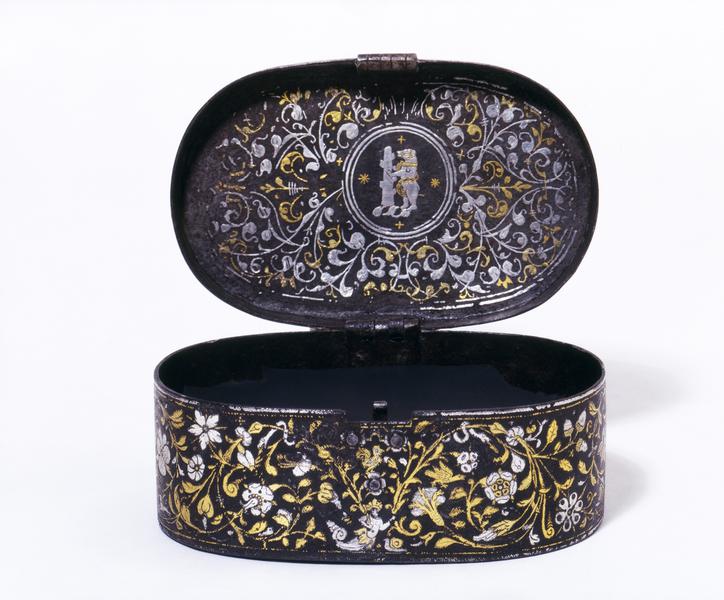
This beautiful box was made in 1579 for Robert Dudley, Earl of Leicester and Elizabeth I's favourite. It's original purpose was to contain sweetmeats. Robert Dudley's personal crest is on the inside of the lid and it is believed to have been a present - possibly for New Year since sweetmeat was a common present at this time of year.
The box is made of iron and has been decorated with a special technique known as "damascening" - the silver and gold ribbons would have been mixed with the iron.

Monday, 18 February 2013

Seal of Arthur, Prince of Wales


This was the wax seal of Arthur, Prince of Wales while he was heir to the English throne. Sadly, he never got to use it as a monarch due to his early death. The coat of arm is flanked by his personal badge with the large feather.

Friday, 15 February 2013

Coins of the Realms

The monarch was - and still is - the face of a monarchy's currency. That was the same in Tudor England and some of the coins have survived as a testimony to an age long gone by.


1. Coin from Henry VIII's reign
2. Early groat from Henry VII's reign
3. Elizabethan coin depicting the Queen and the Tudor rose
4. A golden coin from Mary I's reign. It depicts Mary on a ship carrying a sword and shield
5. Coin made during Henry VIII's marriage to Catherine of Aragon
6. A silver groat from the time of Mary I

Wednesday, 13 February 2013

The Boleyn Cup & Table Fountain

The Boleyn Cup belonged to Anne Boleyn herself and carries Anne's falcon (with it's crown) placed on a tree stump. The cup was made out of silver and gilt. After being in Anne's possession it actually went on to her daughter, Elizabeth I, which is special when you consider how few of her disgraced mother's possessions Elizabeth received. Elizabeth gave it as a gift to her physician, who decided to give it to the church. Today, the cup is still in the possession of the church and can be seen at St. John the Baptist Parish Church in Gloucestershire.


The drawing is of a table fountain designed by Hans Holbein and was designated as a New Year's present to Henry VIII from Anne Boleyn in 1534. Her falcon is engraved into the fountain - one can only imagine what Henry did with it after Anne's execution.

Remainder of a Short Reign


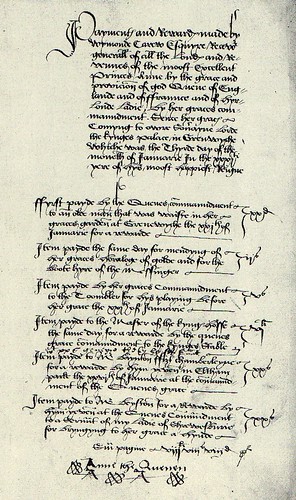
This is a rare document from the very short reign of Anne of Cleves as Queen of England. It carries her signature, Anne the Quenen. Few documents like this has survived due to the shortness of Anne's reign which meant that she simply did not have enough time to use her new powerful signature.

Seal Purse of Elizabeth I


This seal purse is embroidered with the Great Seal of England and Queen Elizabeth's initials: ER (Elizabeth Regina - Regina being the Latin word for Queen). The Great Seal of Elizabeth was carried in this purse in a procession before the Lord Chancellor and Keeper of the Seal.
Originally, the Seal Purse was a purse of plain white leather but when Elizabeth ascended to the throne, it had developed into an elaborate piece of work - the Tudor rose is embroidered as well.

The Great Seal itself was of extreme importance. It was by this seal that every official document would be marked and if the document did not have the seal on it, it meant that the Queen had not been consulted - and that was a dangerous thing to forget.

It was a tradition that the Lord Chancellor or Keeper of the Great Seal was allowed to keep the Seal Purse when there was no longer any use for it - normally when the monarch in question either died or had another one made. This particular purse was given by Thomas Egerton (Lord Chancellor in 1596) to his servant Henry Jones whose family transformed it into a cushion cover and added the wheat ears at the edge.

Henry VIII's Astronomical Clock


King Henry VIII ordered this astronomical clock for the decoration of Hampton Court Palace in around 1540 - right after Cardinal Wolsey had fallen from power and Henry VIII began to rebuild his newly-acquired palace. Within the clock there are three bells of which the oldest is from 1478. The clock is very complicated compared to the clocks we use today and it shows:

  • The hour 
  • The month
  • Day of the month
  • The position of the sun in the ecliptic
  • The twelve signs of the zodiac
  • The number of days that have elapsed since the beginning of the year
  • The phases of the moon
  • It's age in days
  • The hour in which it crosses the meridian which means that it tells the time of high time in London
Since Henry VIII often used to travel by barge to Hampton Court Palace it was practical to know when it was high tide and thereby the best time to travel by. 
The earth is centred in the middle of the clock because the clock was made before Copernicus and Galileo began to doubt the heliocentric world-image (where the sun is the centre of the universe). The minor circle is the sun that was said to circle around the earth at the time. 

Tuesday, 12 February 2013

Hair of a Tudor


The hair in the locket to the left belongs to Mary Tudor, who was Queen of France for a short while. Born as a Tudor, Mary was the daughter of Henry VII and Elizabeth of York - consequently making her the sister of Henry VIII and Arthur. The hair is the notorious Tudor-red that is said to have been a trademark of the Tudors - both Henry VIII and Elizabeth I were famous for their copper-red hair.

The hair was taken from Mary's tomb in 1784 on September 6th when her tomb at St. Edmundsbury was opened for the first time ever since it was interred after Mary's death.

Wolsey's Portable Sundial


It is a bit difficult to see what that golden thing to the left actually is and when it was made it was quite a marvel as well. It is a portable sundial that belonged to Cardinal Wolsey. The symbol of the Bishop of York and Wolsey's "Cardinal" symbol is engraved on the sundial.

At the time of its creation, technology was fascinating and many people were very interested in every science imaginable. It can only be imagined that the sundial is such an object that Henry VIII would have confiscated when Wolsey fell from power and the King confiscated the Cardinal's belongings.

Monday, 11 February 2013

Elizabeth I's Bedspread


This bedspread was used by Elizabeth I when she visited Berkeley Castle in 1572. Allegedly she left several items there including the bedspread and a pair of gloves.

Elizabeth never visited Berkeley again - perhaps the reason for this was that she disliked the owner. Henry Berkeley was in the middle of legal feud with the Lisle family and involved the crown - obviously to Elizabeth's irritation.  

Sunday, 10 February 2013

Mary I's Psalter

This Psalter was made in the 13th century but it is unknown what happened to it until 1553 where the customs officer Baldwin Smith presented it as a gift to Queen Mary I.
Mary valued the book highly and had it rebound with her device, the pomegranate, which she had adapted after her mother. The pomegranate is sewn with golden thread on a velvet background.

The Psalter is far from the ordinary Psalters. It contains many illuminated parallels - all done by the same artist. The book contains more than 800 illustrations that are beautifully executed. The clasps are engraved with Tudor emblems of fleur-de-lis, portcullis, a lion and a dragon - this was to make it clear that it was the Queen's personal belonging.


Saturday, 9 February 2013

Henry VIII's New Year Lists

Surprisingly enough - two of Henry VIII's New Years Lists has survived to this present day! The first is from 1534 and the second is from 1539 - just five years between them but it made a huge different to Henry's personal life which can be seen in the receiving names on the lists.

1534
The first list is Henry VIII's New Year List for who he was sending New Year-presents in 1534. But there is one person whose name is clearly missing from the list - Princess Mary or Lady Mary as she would be at that time. She still refused to accept her father's marriage to Anne Boleyn and thusly she is not included in her father's list - apparently he would not even send her a single present. The King's personal signature is clearly written as the very first name on the list and can also be found further down the scroll.

The second list is written by Henry VIII of the people to whom he would give New Year presents that year. The list is written around New Year's Day and is ranked from the most important to the least important. Some familiar names pop up when reading the scroll. At the top of the list was the "Lord Prince (Edward), the Lady Mariee (Mary) and the Lady Elizabeth" -
1539
all three children were in the succession at the time. These three royal children are followed by a long list of bishops and after that the lords, duchesses and countesses.


Bed head of Henry VIII and Anne of Cleves


This bed head was designed for Henry VIII's unsuccessful marriage to Anne of Cleves. It was made in England in 1539 but since the marriage was broken up six months later it probably was not used for some time. It is currently held by a museum in Glasgow.

The description in the middle panel is describing Henry VIII as the King of England and France, Lord of Ireland and head of the Church of England. The left panel bears the royal motto, Dieu et mon droit (God and my country) and the right panel has the initials of Anne and Henry surrounded by sign of fertility.

Friday, 8 February 2013

Elizabeth 1's Locket Ring


This ring was worn by Elizabeth 1 until the day of her death and when her courtiers removed the ring they discovered that it was a locket. The two pictures depicts Elizabeth herself (lower portrait) and her mother, Anne Boleyn (upper portrait). Ever since Anne Boleyn's execution she had almost never been talked of. Elizabeth herself could not mention her mother in public since her death had caused such great scandal and her name had been tarnished ever since.

The ring itself is made of mother-of-pearl  and is adorned with rubies. On the lit there is an "E" written with diamonds.


Close-up of the two portraits