Showing posts with label tudor-scandals. Show all posts

Wednesday, 17 July 2013

Untimely Play, Madam

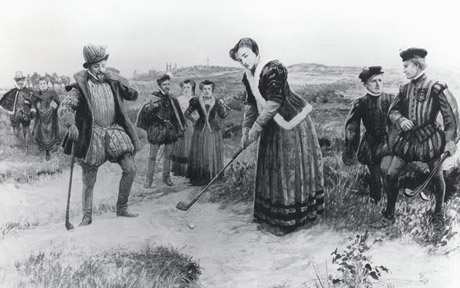
A romantic depiction of the Scottish
Queen playing golf
Mary, Queen of Scots was definitely a cause for many scandals in her time but there was one incident that not even her own supports could overlook. The thing was that Mary loved to play golf (and is generally believed to be the first woman in Scotland to do so) which seems harmless enough. She was taught the game during her time in France as Dauphine to the French throne and took it with her back to Scotland after her first husband's death - perhaps it had already arrived as a form of entertainment but sources are unclear on this. So where's the scandal?
When Mary's husband Lord Darnley was murdered in 1567 it was expected of the grieving widow that a proper amount of time would be spent in mourning. However, Mary went out and played her beloved golf just days after the murder! Even the Catholic church - which had so far supported Mary in everything - was outraged.
The "foul play" took place at Seton House; it is likely that it was here Mary lost to one of her ladies-in-waiting, Mary Seton. As a reward Mary gave her namesake a necklace which still survives to this day.

Tuesday, 14 May 2013

Striking Gentlemen

The Tudor age was filled with great lords who constantly watched over their rivals. But sometimes even the most sofisticated men of England turns to more "medieval" ways.
The Privy Counsil's members were appointed by the King and thus a seat on the council was a great honour. An honour that - according the Henry Howard, Earl of Surrey - should not befall those without the right ancestry. Henry Howard was immensely proud of his aristocratic roots and firmly believed that "lesser men" such as Edward and Thomas Seymour were not worthy of such an honour because they had merely been admitted to the King's inner circle due to the King's marriage to their sister.

Edward Seymour

In 1537 records show that Henry Howard had been arrested and imprisoned at Windsor for striking Edward Seymour! The incident took place at the royal residence of Hampton Court Palace and there were strict rules as to what was allowed; an violence in this manner - and between gentlemen - was certainly not allowed. The penalty was severe for the punishment and were it not for Thomas Cromwell's intereference, Henry Howard would have lost his right hand! This would have made a military career impossible which was one of the things that Henry wanted the most.

But, apparently, Edward Seymour was proud as well and determined not to be spoken against. His power grew steadily - especially after the death of Jane Seymour - and in 1546 the episode happened again. This time it was Edward Seymour who hit Bishop Gardiner in the face during a meeting of the Privy Council! Bishop Gardiner was a part of the staunch opposition to the Protestant Seymours and that had eventually resulted in yet another public outbreak amongst the greatest men in England.

Wednesday, 1 May 2013

Who was responsible for the boiling of Richard Roose?

Richard Roose was the cook of Bishop John Fisher and became the first victim of a change in the law that now made it legal to boil people alive as a capital punishment. Bishop John Fisher had had guests who died after eating a soup prepared at the Bishop's house - the Bishop himself survived.

Immediately the cook was pointed out as guilty of poisoning. Henry VIII changed the law (as he would do on other circumstances) and hereby sentenced Richard Roose to a horrible execution: he was to be boiled alive. On April 15, 1532 Richard Roose was taken to Smithfield where he was boiled alive in a large cauldron in front of a large crowd. His execution is estimated to have lasted for two entire hours.

Rumours circled at court that it was not the cook who had poisoned the soup but someone else far closer to the crown itself. The courtiers were quick to name Anne Boleyn and her fraction as the real poisoners. It would seem logical that the Boleyns wanted to assassinate Bishop Fisher due to his refusal to acknowledge Anne as Queen - however the Bishop would be beheaded not long after. But was it true?

The answer must be no. There was - and still is - no evidence that either Anne or anyone in her fraction had bribed the cook to poison the Bishop. But the rumour remained, lurking in the background; it was one of the many rumours that aimed at demeaning Anne Boleyn and make her look like .. well, a witch. Henry VIII certainly never believed it and he was even said to have cruelly exclaimed: "I cooked the cook!" as a joke to his courtiers. It is still unknown who actually poisoned the Bishop and his guests - it would seem strange that the cook should poison his master when he does not appear to gain anything from it.

Saturday, 2 March 2013

Royal Insult!

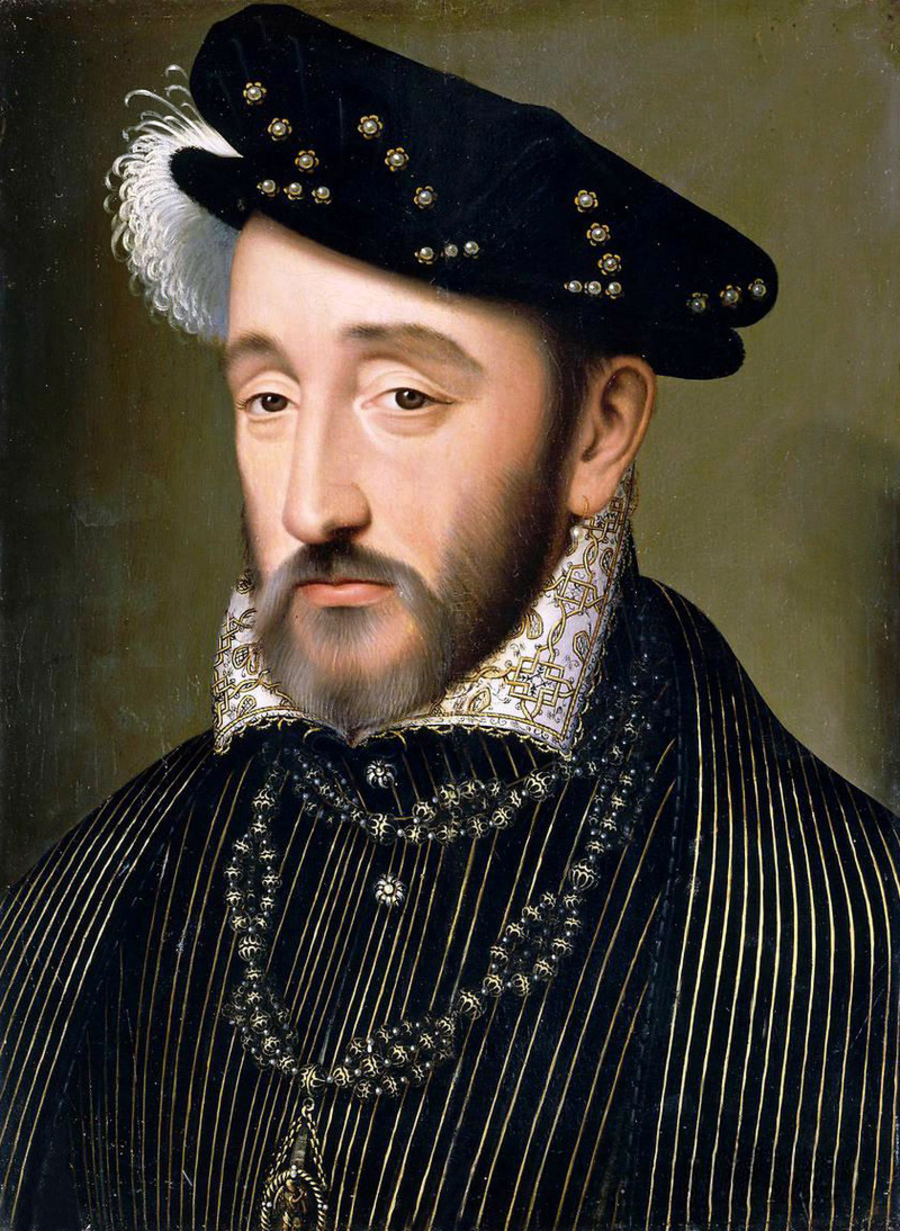
Henry II of France
When Mary I declared war on Henry II's France in 1557 the message barely reached the French King. Mary had been persuaded by her husband that their two countries of England and Spain should join in an attack on France - and Mary was ready to help her husband.
But when her herald arrived at the French court with the important message, he was blown off! Despite knowing that the English Queen had a herald waiting with a message, Henry II chose to go hunting - for two days! When the French King finally headed back to the palace and granted the English herald and audience he would not accept the message of war and interrupted the herald.
It was unthinkable that a woman should declare war on him!

There is no doubt that the incident - not unnoticed by the many courtiers - was a great insult to the English Queen. By refusing to take the declaration of war seriously, Henry II also public showed that he had no respect for the female ruler of England.


Mary I

Sunday, 17 February 2013

Not Becoming of A Christian Princess

It is - and was - not a secret that Princess Mary and Prince Edward did not see eye to eye on religious matters but as it turns out, the siblings had different views on royal behaviour.

Prince Edward wrote to Catherine Parr, asking her to keep the Princess Mary from dancing foreign and exotic dances. In his own words Mary should "attend no longer to foreign dances and merriments which do not become a most Christian Princess." You can almost imagine Mary's indignation towards being reproved by her younger brother on her behaviour.
Despite personal pride, Mary may also have found a sort of comfort in the foreign dances since her mother had brought many Spanish and "Moorish" dances to the English court when she arrived to marry Arthur, Prince of Wales.

Thursday, 14 February 2013

Mary Tudor's Dislike of Katherine Howard

When Henry VIII married (yet) again to his fifth wife, Katherine Howard, the new Queen did not charm the entire court. Actually you do not even have to look beyond Henry's own family to find an intense dislike.

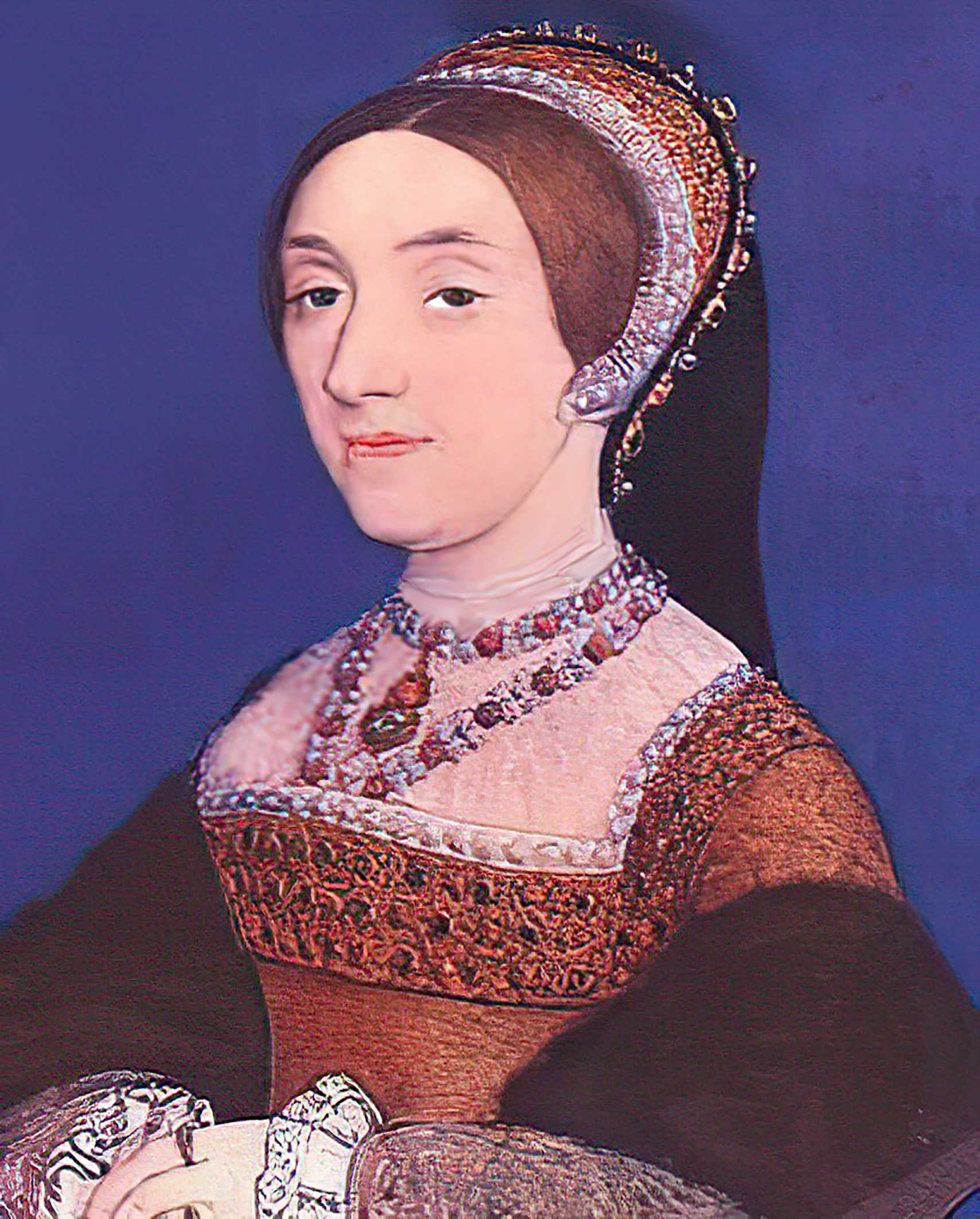
Princess Mary was far from satisfied with her father's new wife. The dislike may have routes in two things: first of all, Katherine was 9 years younger than Mary and it is possible that Mary may have felt jealous at this young woman who was certainly more unintelligent than herself but still married - it was considered an embarrassment to grow old as a spinster and despite that Mary was not old, she was still older than her father's new wife. Perhaps Katherine reminded Mary of what she wanted - a household of her own.

Secondly, Katherine's silly behaviour was so far from what Mary had experienced from her first years with her mother, Catherine of Aragon, that Mary may have found it difficult to accept a young, giggling girl sitting at the throne her mother had sat in. It is very likely that the immensely proud Mary saw the marriage of her father as a demeaning to the image of an ever-dignified Queen that Catherine of Aragon had imprinted on her daughter.

But the dislike turned into a scandal when Katherine noticed the hostility from Princess Mary and consequently complained to her husband. To prove her new status Katherine had two of Princess Mary's maids removed which was a public humiliation and the scandal was well-known.
Princess Mary
Katherine Howard


Tuesday, 12 February 2013

The King's 26 Ladies

After the discovery of Katherine Howard's adultery, Henry VIII was furious and embarrassed. He felt that Katherine had made a fool of him by cheating on him not only with a man he liked but with the knowledge of other courtiers! So at the end of January, while Katherine awaited her execution, the King decided to cheer himself up.

The King decided to throw a ball - inviting only twenty-six ladies to dine with him and thirty-five to dine at a table near by. No gentlemen were admitted to the ball. Even at the time it caused quite a scandal.

It can only be assumed that Henry wanted to surround himself with beautiful women to make himself forget the embarrassment he felt over the one he had locked up in the Tower. Since Katherine had always helped him to feel young again, it can be assumed that the elderly King wanted young and beautiful women (no less than 61 in total) could help to restore that feeling of youth - and in that case it would only be annoying to be distracted by the presence of other men.

The dinner party as it was depicted in "The Tudors"

Sunday, 10 February 2013

A Scandal of Playfulness?

A scandal that occurred after Henry VIII's death is still a source of debate. A juicy rumour of the Dowager Queen, her husband and the King's daughter is bound to be a source of interest - then and now. So let's take a look at a typical Tudor rumour:

When Catherine Parr had married Thomas Seymour (another scandal!) she invited the Lady Elizabeth to stay with her and her new husband at Sudeley Castle. Lady Elizabeth - and her ill-fated cousin Lady Jane Grey - accepted the invitation. But soon things got out of hands in the peaceful household. Allegedly, Thomas Seymour would engage in inappropriate games with the young princess Elizabeth which involved him tickling the princess - something that was not socially acceptable in a respectable relationship. But to make the scandal even more interesting the rumours has it that Catherine Parr herself joined in!
Apparently it was more than Catherine would accept when she supposedly found her husband embracing the Lady Elizabeth who was consequently sent to another household to stop the whole thing.

But is it true?

Probably not. One always has to consider the source and in this case it is "Kat" Ashley - Elizabeth's governess. Though she would be considered a reasonable witness in normal circumstances, she is not that reliable in this case. The situation was that Kat Ashley was imprisoned in the Tower when she told the story and had been threatened with torture - enough to make anyone lie. Except for her, there is nobody who has ever claimed that the incident took place. So it is reasonable to assume that the poor governess (otherwise completely loyal to Elizabeth) only told the story to spare herself the horrors of the torture chamber. Nevertheless, the story must have caused quite a scandal at the time. 

Saturday, 9 February 2013

Pleading Jane

The French ambassador who was stationed at the English court during Henry VIII's marriage to Jane Seymour has reported an incident that has gone remarkably unnoticed by. It is today a well-known fact that Henry and his third wife, Jane, disagreed on the question of the monasteries. Henry had by this time already closed many monasteries and it is reasonable to assume that he was not going to give it back; first of all he would be obliging a church he had left and secondly the monasteries had brought him considerable more wealth and power.
But Jane - otherwise described as ever obedient - threw herself at his feet when hearing of the fate of the monasteries. The incident took place in front of the whole court. She begged Henry to restore the monasteries but Henry retorted her and told her to get back on her feet. When she was standing again, Henry - loving as ever - reminded her that he had already told her several times not to meddle in his affair. And then the King sunk to a lower level by making a pointed allusion to what he called "the late Queen" - that being Anne Boleyn who had been executed a few months earlier.

Since then there has been no more reports of disobedience from Jane's side - she was probably terrified and with good reason. But it casts a new light on the image of a Jane that never said a word against her husband. After all, Henry said that he had told her "several times"; an indication that she had brought up the subject before.

Queen vs. Duchess

One of the scandals at the time was the renowned cat-fight between the Dowager Queen Catherine Parr and the Duchess of Somerset, Anne Seymour (Stanhope).

So here are the juicy details:
Anne was convinced that Catherine Parr possessed a lower rank than herself by marrying Thomas Seymour who was the younger brother of Anne's husband - and therefore far less important. When Anne was asked to carry Catherine's train, the Duchess refused. But the scandal peaked when Anne took the Queen's place at the hearing of matins in the chapel. Allegedly Catherine then grabbed Anne's arm.
In the end Catherine Parr won the rivalry because she referred to the Third Succession Act that clearly stated that Catherine had precedence over any lady at court. It also meant - probably to Anne's horror - that Anne also came after Lady Mary, Lady Elizabeth and Anne of Cleves.

Whether the story is true is difficult to know for sure because the only source (at the moment) is the Spanish Chronicle that is known for stating rather unlikely things.
Anne Stanhope
Catherine Parr