Showing posts with label rebellions-and-assassination-attempts. Show all posts

Friday, 30 August 2013

Wyatt's Rebellion

Sir Thomas Wyatt was the "Wyatt" in question who began the rebellion alongside the Duke of Suffolk and Carew. It began in 1554 when the news of Mary I's intention to marry Philip of Spain had spread to the wide part of the population - and it was not a popular match. It was not so much the Spanish King who was the problem but rather the religious oppression he would bring with him; the English had just gotten used to a more liberal church and desperately wanted to prevent the Spanish Inquisition from sweeping through England.

The overall plan was to overthrow Mary and replace her with her half-sister Elizabeth who was then to marry Edward Courtenay whom Mary had already rejected as a husband (a bit slighted..?). In order for this plan to succeed the rebels would have to stage the rebellion at three key places: Kent, the Midlands and the West Country. Meanwhile a French fleet - who was fearing that a Spanish husband with Habsburg blood would pose to much of a threat - would take up the main part of the English Channel so that continental aid could not reach Mary. As with all rebellions all this was to take place without the Parliament's knowledge.

But then it went wrong. First of all the Parliament already knew that something was happening thanks to Simon Renard who was the Imperial Ambassador who contacted Stephen Gardiner. This would normally be reason enough to "cancel" a rebellion but the disaster was not over yet. It would seem that Wyatt had grossly misplaced his key locations for the rebellions. The West Country's population was mainly Catholic and as such would never have seen it as a problem that their Catholic Queen married a Catholic King. The loyalty that Mary had been promised at her coronation was still clear in the memories of the people of the Midlands who did not want to commit treason against their Queen. Consequently, the Duke of Suffolk found himself with only 140 men and in a very dangerous position.
Meanwhile, Stephen Gardiner had taken Edward Courtenay into interrogation. Because of his noble descent Courtenay would normally not be tortured but the protocols mentions that the interrogation was "robust" - perhaps an indicator that Gardiner disregarded Courtenay's privileges. Either way Courtenay soon began talking and told them everything he knew off.

It was only Thomas Wyatt himself who had had any sort of success with raising an army of 4000 men and now lead them towards London. The Duke of Norfolk was sent on behalf of Mary's government but the Duke had never expected 500 of his men to suddenly change their allegiance and join Wyatt! Wyatt failed to take advantage of this when he decided to wait before entering London - this meant that the city had plenty of time to secure itself. Ludgate was the gate that Wyatt had intended to cross to get to the heart of the city but it had been raised and he had to take his rebels through the narrow gates nearby. And this is where it all ended. Narrow streets are any soldier's nightmare because they leave you open to ambushes. This is was happened to Wyatt's troops and it would be the end of the rebellion.

What happened next?
Mary had been convinced that severe punishments would only help to estrange herself from her people so the punishments were surprisingly mild - for a Tudor, that is. It was about 90 people who were executed including Thomas Wyatt and the Duke of Suffolk. Others were simply let go. Prior to his execution Wyatt had been tortured in order to implicate Princess Elizabeth but he never caved in and as such no evidence could be found.
But there were two other nobles who could no longer count themselves save any more. Lady Jane Grey and her husband Guildford Dudley were both beheaded because it was considered too dangerous to have Lady Jane Grey as a figure whom people could support instead of Mary. So, despite having played no part in the rebellion Lady Jane Grey had to put her head on the block. The Wyatt Rebellion might have been put down but the displeasure of Mary's marriage was still widely felt by the population which would later add to Mary's rising unpopularity.

Thomas Wyatt

Claimed to be Wyatt's list of arms
Depiction of Wyatt's execution

Saturday, 29 June 2013

The Cornish Rebellion

Henry VII was determined to fill the treasury to its limits and he succeeded. But in doing so he had to raise taxes which led to a rebellion in Cornwall in 1497. It was Michael Joseph (An Gof) and Thomas Flamank - who was a blacksmith and a lawyer respectively - who eventually took the lead. In May they led a 15.000 man army towards Devon and when they reached Wells they had gained an influential ally: the Baron Audley.

But the militia had not expected to meet no resistance whatsoever from the King's side and they began to realize that they could not push the King aside with the relatively small army. So, Thomas Flamank suggested that they sought support in Kent since several rebellions had started here. But the people of Kent was unwilling to aid the rebels and even enlisted in their Earl's armed forces against him. And that was not the only misunderstanding made in the rebel camp. Henry VII had not sat quietly with his hands in his lap (did he ever?) but had called back 8000 soldiers back from his war with Scotland. Meanwhile the royal family had moved to the security of the Tower of London. The citizens armed themselves and prepared to defend their King.
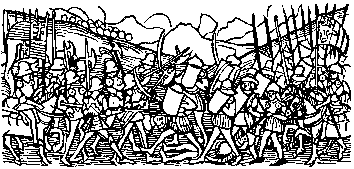
Simple drawing of the Battle of Blackheath

Henry VII sent out 500 men armed with spears on June 14 which seems to have been too much for the Cornish rebels to handle at once. They retreated to Blackheath where they would set up their last camp. Despite good leadership from Michael Joseph, some of the rebels were terrified as they lay up on a hill, looking down towards the Thames and some choose to desert. This would reduce the army to 9-10000.
The final battle was to be at Blackheath itself (though the battle is also referred to as the Battle of Deptford Bridge) and took place on June 17, 1497. By then Henry VII had gathered 25.000 men including cavalry - the elite soldiers of the day. Lords Oxford, Surrey and Essex led the three battalions and the rebels surrendered that same day.One of the great mistakes of the rebels was to fail sending support to the archers positioned at the crossing of the river Deptford Strand and another was to simply release Lord Dauberny when they actually managed to catch him. It is estimated that between 200-2000 rebels died.

The King's Wrath
Michael Joseph (An Gof) gave the final word to surrender and then fled to Greenwich but was caught. Both Baron Audley and Thomas Flamank were caught on the battlefield itself. Now the time had come to face Henry VII's vengance. Some prisoners were sold into slavery while Michael Joseph and Thomas Flamank was sentenced to death - at first they were to be hanged, drawn and quartered but some sources claims that they were "merely" hanged and then their bodies were dismembered. Their executions took place on June 27, 1497 at Tyburn while Lord Audley (being a part of the nobility) was beheaded within the Tower the next day.

Monday, 15 April 2013

The Pilgrimage of Grace

One of the greatest rebellions during Henry VIII was undoubtedly the Pilgrimage of Grace.  The King and Thomas Cromwell had set the Protestant Reformation in motion which had meant the closure of many abbeys and convents all through England. Especially northern England was known to be particularly attached to the Catholic faith. But the rebellion was not against Henry VIII as a monarch but at the very changes that swept through the country.

It all began in Lincolnshire at St. James Church on October 1 1536 where the frustration due to the closure of the abbeys became too much for the inhabitant of Louth to bear. The rising spread to other villages nearby  who demanded that the King's Ten Articles should be removed and the monasteries restored. About 40.000 led by minor gentlemen occupied Lincoln Cathedral. But the uprising was short-lived. By October 14 Henry VIII announced that if the rebels did not disperse he would send the Duke of Suffolk (Charles Brandon) and his forces to settle the matter - only a few remained after a threat such as this. The local leaders were hanged, drawn and quartered as was the punishment for treason.

The Lincolnshire rising may have died out but the movement behind it had not. One day before Henry VIII's public threat - October 13 - the Pilgrimage of Grace began. This new uprising was based on several complaints from the northern populace:
First of all the harvest of 1535 had been poor which had increased the food prices and the Statute of Uses did not help to improve the situation.
Secondly, the people was not pleased about the King's marital affairs. They had not liked how the King had discarded Catherine of Aragon in favour of Anne Boleyn but when Anne Boleyn was executed it was the last drop. The charges against her were clearly trumped-up and lacking any real evidence which was too much for the northern people to cope with - one Queen was bad, but two was too much.
Last - but definitely not least - was the issues with Cromwell's religious reform. As stated, the church meant the world to northern England to whom it was the very centre of community life. When rumours began circulating that a new tax on baptism would be enforced the people could no longer ignore it - combined with the dissolution of the monasteries, the Ten Articles and the new prayers it changed too much too fast.

Every uprising have to have a leader and the Pilgrimage of Grace was no exception. Robert Aske was chosen to be the head of the rebellion. In 1536 Robert Aske had gathered 9.000 rioters and headed for York; the city would be occupied by the rebels soon after. Robert Aske also arranged for the previous monks and nuns to return to the monasteries from which they had been evicted - this was a direct defiance of the King's will. Several noblemen who shared the rebels desire to maintain the Catholic faith began to negotiate with Aske who was now supported by 30-40.000 people - the noblemen in question was Thomas Howard, Duke of Norfolk and George Talbot, Earl of Shrewsbury. King Henry VIII instructed the Duke of Norfolk to offer the rebels a royal pardon from the King himself and the assembly of Parliament at York. The offers were delivered and Robert Aske dismissed his followers - you have to remember that the rebellion was not against the King and that the people still supported him.

But not all of the northerners shared Robert Aske's conviction that the King would be true to his word. A new rebellion broke out in Cumberland and Westmorland and this new rebellion was named the Bigod's rebellion. The King reacted promptly and arrested Aske (Henry VIII was convinced that Robert Aske had known about the new rebellion), Lord Darcy, Lord Hussey and other leaders. To the Duke of Norfolk, King Henry wrote:
You must cause such dreadful executions of a good number of the inhabitants [...] hanging them on trees, quartering them and setting their heads and quarters in every town, as shall be a fearful warning. 
 This meant the end of the rebellion and the end of the rebel leaders' lives.

Lord Darcy and Lord Hussey were beheaded for their involvement. Sir Robert Constable and Sir Francis Bigod were hanged at Tyburn and Thomas Moigne (Member of Parliament) was hanged, drawn and quartered in March 1537. Robert Aske had pleaded the King not to be hanged, drawn and quartered and the King agreed - but Robert Aske's altered punishment was not much better: Robert Aske was hung in chains from York Castle.
In total the rebellion ended with the executions of 216 people including several knights, munks, priests and members of the nobility. Actually, Henry VIII emerged from the rebellion as more powerful than ever - he had successfully struck down a rebellion without losing any of his royal power or authority.

These are some of the nobles that were executed and how they met their ends:

Sir John Bulmer - Hanged, drawn and quartered
Lady Margaret Stafford - Burned at the stake
Sir Edward Neville - Beheaded
Sir Thomas Percy - Hanged
Sir Stephen Hamerton - Hanged
Sir Nicolas Tempast - Hanged

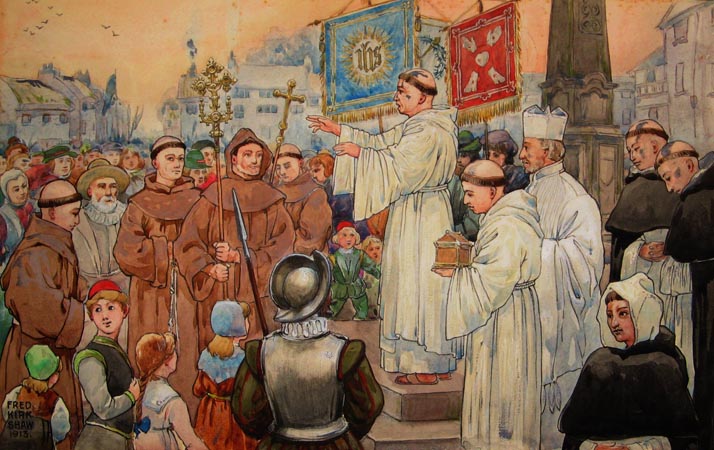
Here are some illustrations of the Pilgrimage of Grace:

This was the badge chosen to represent the Pilgrimage of Grace.
The shield is "adorned" with the five wounds of Christ and is crowned
with his crown of thorns


Court scroll regarding the Pilgrimage of Grace
Here you have it - the pardon from Henry VIII from 1537 including a list of those who
were not pardoned
"Beginning of the Pilgrimage of Grace" by Andrew Benjamin Donaldson 1537
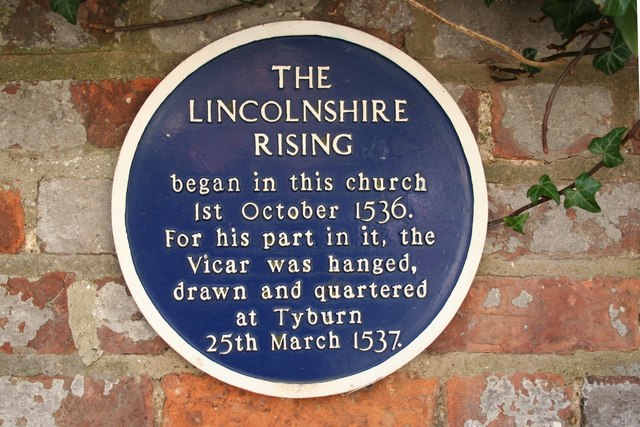
Plaque that hangs outside the church in Lincolnshire where it all began


Monday, 18 February 2013

Assassinating the Queen

Elizabeth I faced countless terrors and threats to her life through her entire life. One of the most memorable assassination attempts on the Queen occurred when Elizabeth was travelling on a barge down the River Thames.
Panic broke out when a shot was fired and a guard fell down - shot by a bullet that obviously was meant for the Queen. Elizabeth gave the man her personal hanker-chief to press against his wound. As she did so, she assured him "Be of good cheer, for you will never want. For the bullet was meant for me."

There has been theories that the incident was not an assassination attempt at all but a salute made to the popular Queen that eventually went wrong. However, considering the many attempts on Elizabeth's life, it is possible that it indeed was an assassination attempt.