Showing posts with label symbolism-in-coat-of-arms. Show all posts

Saturday, 14 September 2013

Wolsey, Wolsey


The fable creature (bottom photo) is holding a banner with Thomas Wolsey's coat of arms when he was Archbishop of York. The left part of the banner is the coat of arms of the archbishopric of York while the right is Wolsey's personal emblem. Notice that the banner has been crowned with a Cardinal's hat - a very obvious reference to his appointment from the Pope. It should be said, however, that the Cardinal's hat is not a part of the actual emblem but is a part of that of the Christ Church.
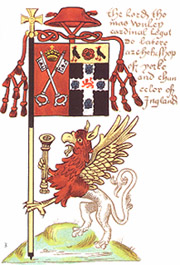
File:Wolsey banner.jpgCardinal Wolsey's personal coat of arms is now that of the Christ Church which he founded. Like the one beneath it is crowned with a Cardinal's hat though a black one. Wolsey was born in Suffolk and as such he has symbols belonging to the nobles of that shire. The silver cross is from the Uffolk Earls of Suffolk while the four blue leopards from both the Dukes of Suffolk and the de la Pole Earls. Notice the Tudor rose topping all this as a reference to Henry VIII and his house of Tudor. The red lion is the chosen emblem of Pope Leo X who was Wolsey's patron. The two black birds are derived from Thomas à Becket's coat of arms.

It can be found on all the buildings that Wolsey created and I am sure that if you search Hampton Court Palace you will find at least one example of this coat of arms as a reminder of the palace's original builder.

Sunday, 5 May 2013

A Rising Maiden


Catherine Parr's badge depicts a young, crowned maiden rising from the core of a Tudor rose. The maiden is a symbol of youth and a innocence; the crown is of course to show Catherine's regal status. The loose hair was only used for weddings and by unmarried young ladies.
Unlike many of her predecessors as the wife of Henry VIII, Catherine looked to her family history for inspiration: the Parr family's crest consisted of a maiden.

Wednesday, 13 February 2013

The Rose Without a Thorn


Katherine Howard - with her obedient motto - had of course chosen her badge from the nick-name Henry VIII had given her: His rose without a thorn. So, consequently, Katherine's main feature is a rose without a thorn. The rose petals are the united colours of Lancaster and York - another symbol of her obedience towards her husband and his family.
It is a more feminine version of Henry VIII's own badge.

Badge of the German Princess


Anne of Cleves' badge is very different from Henry VIII's previous three wives in colour and form. The escarbuncle (the main feature of her badge) is a symbol sovereignty or a precious gemstone. Her badge was not as packed with symbols as the other Queen's had been - in fact the only unique feature of any meaning other than the escarbuncle, is the colour: gold.
Gold symbolised not only the luxury colour that we associate it with but both generosity and enlightenment. But - as we know - Anne's badge spent a minimum space of time on the walls of the royal palaces.  

Jane Seymour's Phoenix


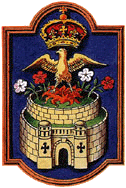
Like her predecessors - and successors - Jane Seymour had her own personal badge. The phoenix is not only the symbol of rebirth but also that of love. That Jane added it as the main figure to her badge was probably to show that Henry's love for her was a rebirth from his marriage to Anne - much like Anne Boleyn did before her. The fort represents a safe haven or a home - those exact things that Jane became known for.
Once again the red and white Tudor flowers that spring from the castle alongside the newborn phoenix symbolises the heirs that would spring from the safe home she would provide.

Saturday, 9 February 2013

Anne Boleyn's Falcon


Anne Boleyn's badge is packed with symbolism. The crown symbolises her elevated status as Queen of England. The falcon is normally associated with someone who does not rest until their goal is achieved - I must say that it fits perfectly with Anne. She was able to use it because her father was a descendant of the Earl of Ormonde who had a falcon on his badge.
The tree stump represents the bareness of the Tudor-stock in Henry's earlier life and the roses indicates that through her Henry will get many successors. The sceptre is a symbol of power given by God - only royalty was given this power.

Sometimes Anne's falcon has been depicted hacking on a pomegranate - the symbol of Catherine of Aragon.

Catherine of Aragon's Pomegranate


Catherine of Aragon used this badge during her time as Queen of England. The pomegranate with its peak to the seeds symbolizes fertility and abundance. Besides, the pomegranate was an exotic fruit and also represented Catherine's Spanish heritage.
The pomegranate is crowned which symbolises sovereignty and was the ultimate power symbol. 

The Tudor Rose

The Tudor family used a so-called "Tudor Rose" as their badge and had done so ever since Henry VII became the first Tudor-king. Henry VII united the two families of Lancaster and York by marrying Elizabeth of York and uniting the two families' badges as well. He mixed the red rose of Lancaster and the white rose of York in one badge that would serve as the dynasty's badge till the end of Elizabeth I's reign.

The Tudor rose
Every badge had its own meaning and the united rose of the Tudors kept the symbolic meanings of each rose:

The red rose symbolises grace and beauty
The white rose symbolises love and faith

The rose itself was very symbolic and was often used to complement a badge or heraldry. Like the lion is first among the land animals, the rose is first among the flowers. When a rose is red in blossom it is generally a symbol of martyrdom.