Well, we all know that the hygiene was lacking (to say the least) at the court of the Tudors. But it appears from recently discovered documents that the Tudors bathed and washed more than we have thought so far. So, let's take a look at some of the Tudors - who were the clean ones and who skipped their baths?
But strangely enough, Henry VIII defied the health advises from the doctors and bathed! At Hampton Court Palace (Bayne Tower) he had a large tub installed which was the height of what technology could do: it was heated by a stove in the room next door and the hot water was led from there to the King's tub. Henry's wound his leg was constantly aching and the King chose to bathe in a mixture of herbs and musk - attempting to ease the pain.
The King even went so far as to take herbal baths - except when the sweating sickness was out.
Mary, Queen of Scots was also fond of bathing. According to rumours the Scottish Queen liked to bathe in wine!
Also Elizabeth I bathed frequently compared to her courtiers. It is reported that the Queen bathed at least once every month - and to her contemporaries that was almost too much! The Queen's sharpened sense of smell might have contributed to the frequent baths but Elizabeth still joins the league of the "clean" Tudors!
But of course, not everyone followed these royal examples as you can see from the following examples:
Anne of Cleves followed German traditions and hardly ever bathed. When she was engaged to Henry VIII her advisers allegedly had to work hard on convincing Anne that she had to bathe before she met the King.
Besides Henry VIII's bath tub at Hampton Court, the royal family also had access to bath tubs at the Tower and Windsor Castle. Henry VIII actually built yet another bathroom at Whitehall at the end of the 1540's.
Other courtiers would buy soap and scented water to clean their hands and douche their bodies. The very wealthy could even afford perfume to sprinkle on the body in an attempt to get rid off the smell.
Showing posts with label elizabeth-i. Show all posts
Showing posts with label elizabeth-i. Show all posts
Wednesday, 20 March 2013

Wednesday, 20 February 2013
An Ageing Queen
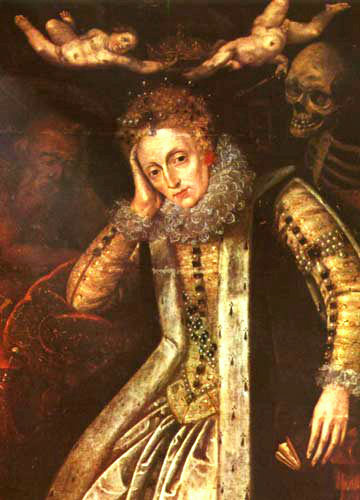
This is one of those rare portraits of Elizabeth I that depicts a woman who is no longer young - to say the least. At the end of her reign, the artists wanted to keep the illusion - for Elizabeth herself and her people - that she was a woman whom time could not affect. It is easy to imagine the Queen being angered by a portrait showing an old woman. This portrait is referred to as the "Allegorical Portrait" and is packed with symbolism.
The Queen is resting her tired head on her hand while two angels (or cherubs) are removing her heavy crown - finally taking a burden of her shoulders. To her right is a man with a long white beard: Father Time. Death is looking over her shoulder to her other side. Everything in this portrait is aimed at depicting the passage of time and that Elizabeth's time is running out.
The portrait was painted in around 1610 which is seven years after the Queen's death. Even if it had been painted when she was alive, it would probably never have been shown to the Queen - considering the notorious Tudor-temper it is likely that Elizabeth would have been less than pleased with it.
Tuesday, 19 February 2013
The Many Faces of Elizabeth I
Elizabeth I was painted a lot through her long reign and these are just a few of the paintings of her. Some of them will appear later with a detailed description in the "Painting the Tudors"-section, so make sure to keep an eye out for it ;)

- Rainbow Portrait
- Armada Portrait
- Darnley Portrait
- Coronation Portrait
- Ermine Portrait
- Hampton Court Portrait
- Portrait by Marcus, the Younger Gheeraerts

- Allegorical Portrait (father time is on her right)
- Pelican Portrait
- Coronation Procession
- Phoenix Portrait
- Untitled
- Young Princess Elizabeth
- Young Queen Elizabeth
Monday, 18 February 2013
Assassinating the Queen
Elizabeth I faced countless terrors and threats to her life through her entire life. One of the most memorable assassination attempts on the Queen occurred when Elizabeth was travelling on a barge down the River Thames.
Panic broke out when a shot was fired and a guard fell down - shot by a bullet that obviously was meant for the Queen. Elizabeth gave the man her personal hanker-chief to press against his wound. As she did so, she assured him "Be of good cheer, for you will never want. For the bullet was meant for me."
There has been theories that the incident was not an assassination attempt at all but a salute made to the popular Queen that eventually went wrong. However, considering the many attempts on Elizabeth's life, it is possible that it indeed was an assassination attempt.
Panic broke out when a shot was fired and a guard fell down - shot by a bullet that obviously was meant for the Queen. Elizabeth gave the man her personal hanker-chief to press against his wound. As she did so, she assured him "Be of good cheer, for you will never want. For the bullet was meant for me."
There has been theories that the incident was not an assassination attempt at all but a salute made to the popular Queen that eventually went wrong. However, considering the many attempts on Elizabeth's life, it is possible that it indeed was an assassination attempt.
Sunday, 17 February 2013
Elizabeth and Mary: Cousins, rivals, queens

The drama that played out between Queen Elizabeth I of England and Mary, Queen of Scots is still as fascinating to us now as it was 500 years ago. The two queens - who never met - embarked on a lethal rivalry that would only have one winner. A rivalry that would send Mary, Queen of Scots to the scaffold and leaving Elizabeth as the undisputed Queen of England.
In this book the very drama of these two women is played out not only through the two front-figures but by the power and ambition of the men that surrounded both monarchs.
Saturday, 16 February 2013
Modern Elizabeth
I found these beautiful pictures of Elizabeth I in a modern interpretation on:
http://viona-art.com/portfolio/archive/tudor (all credit to this side)
and I thought I would share them:


http://viona-art.com/portfolio/archive/tudor (all credit to this side)
and I thought I would share them:
Friday, 15 February 2013
Coins of the Realms
The monarch was - and still is - the face of a monarchy's currency. That was the same in Tudor England and some of the coins have survived as a testimony to an age long gone by.

1. Coin from Henry VIII's reign
2. Early groat from Henry VII's reign
3. Elizabethan coin depicting the Queen and the Tudor rose
4. A golden coin from Mary I's reign. It depicts Mary on a ship carrying a sword and shield
5. Coin made during Henry VIII's marriage to Catherine of Aragon
6. A silver groat from the time of Mary I

1. Coin from Henry VIII's reign
2. Early groat from Henry VII's reign
3. Elizabethan coin depicting the Queen and the Tudor rose
4. A golden coin from Mary I's reign. It depicts Mary on a ship carrying a sword and shield
5. Coin made during Henry VIII's marriage to Catherine of Aragon
6. A silver groat from the time of Mary I
Elizabeth I - Quotes
The Virgin Queen left her mark and personality for us to see through the quotes that survived her
Wednesday, 13 February 2013
Seal Purse of Elizabeth I

This seal purse is embroidered with the Great Seal of England and Queen Elizabeth's initials: ER (Elizabeth Regina - Regina being the Latin word for Queen). The Great Seal of Elizabeth was carried in this purse in a procession before the Lord Chancellor and Keeper of the Seal.
Originally, the Seal Purse was a purse of plain white leather but when Elizabeth ascended to the throne, it had developed into an elaborate piece of work - the Tudor rose is embroidered as well.
The Great Seal itself was of extreme importance. It was by this seal that every official document would be marked and if the document did not have the seal on it, it meant that the Queen had not been consulted - and that was a dangerous thing to forget.
It was a tradition that the Lord Chancellor or Keeper of the Great Seal was allowed to keep the Seal Purse when there was no longer any use for it - normally when the monarch in question either died or had another one made. This particular purse was given by Thomas Egerton (Lord Chancellor in 1596) to his servant Henry Jones whose family transformed it into a cushion cover and added the wheat ears at the edge.
Elizabeth I
The Greatest Queen of England - the Queen who refused to surrender her crown and submit to a man
 The former Princess Elizabeth was declared a bastard and was stripped of her grand household and her titles. She was allowed to carry the train of her half-brother Prince Edward at his baptism but was not welcome at court at the time - Henry VIII was still convinced that she was a bastard and she probably reminded him of Anne Boleyn.
Through her childhood she was taken care of by three different women in turn: Lady Bryant (who was transferred to her brother's establishment), Lady Troy (who retired between 1545-16) and finally Lady Catherine Ashley (who remained Elizabeth's friend till her death). Elizabeth was a very intelligent child and she soon learned French, Flemish, Spanish, Italian and was able to write Latin, English and Italian.
Tuesday, 12 February 2013
A child for the Virgin Queen?
One of the many rumours that surrounded Elizabeth I after her reign - and to some extent still does - is that she had a child. The rumour goes on to state that the Earl of Essex may actually have been the Queen's own son!
But is it true?
As with most rumours this one is false. Queen Elizabeth never had a son - or a daughter - and if we take a look at her life it will explain why.
First of all, the Queen was constantly surrounded by courtiers and servants. There is absolutely no way that she could have had a child without anyone noticing it - after all a huge belly would eventually give her away. Besides the Queen could not spent much time alone, let alone nine whole months!
Secondly, Queen Elizabeth was very protective of her throne and she knew that if she had a child she would have lost it - along with her people's affection. For a woman who went through so many difficult steps to the throne would give it all away for a child.
And there are no evidences today that the Queen bore any children which is mainly a rumour that has been created to put the Queen's virginity into question.

But is it true?
As with most rumours this one is false. Queen Elizabeth never had a son - or a daughter - and if we take a look at her life it will explain why.
First of all, the Queen was constantly surrounded by courtiers and servants. There is absolutely no way that she could have had a child without anyone noticing it - after all a huge belly would eventually give her away. Besides the Queen could not spent much time alone, let alone nine whole months!
Secondly, Queen Elizabeth was very protective of her throne and she knew that if she had a child she would have lost it - along with her people's affection. For a woman who went through so many difficult steps to the throne would give it all away for a child.
And there are no evidences today that the Queen bore any children which is mainly a rumour that has been created to put the Queen's virginity into question.

Monday, 11 February 2013
Elizabeth I's Bedspread

Elizabeth never visited Berkeley again - perhaps the reason for this was that she disliked the owner. Henry Berkeley was in the middle of legal feud with the Lisle family and involved the crown - obviously to Elizabeth's irritation.
Dressing the Queen
Queen Elizabeth I was the centre of her court and country and was consequently dressed in the very best. Thankfully some of her clothes has survived till today and gives us an insight into the most famous Queen of England and the fashion of her time.

 These silk stockings belonged to Queen Elizabeth and are embroidered at the top. The Queen was fond of embroidered stockings and shoes - preferably made of silk. This particular pair of stockings was a Christmas present to the Queen from Robert Dudley and was given to her during the first New Year's celebrations of her reign.
The boots (to the right) also belonged to Queen Elizabeth and was used by the Queen when she went hunting. The boots are made of leather and shows how thin her calves were.
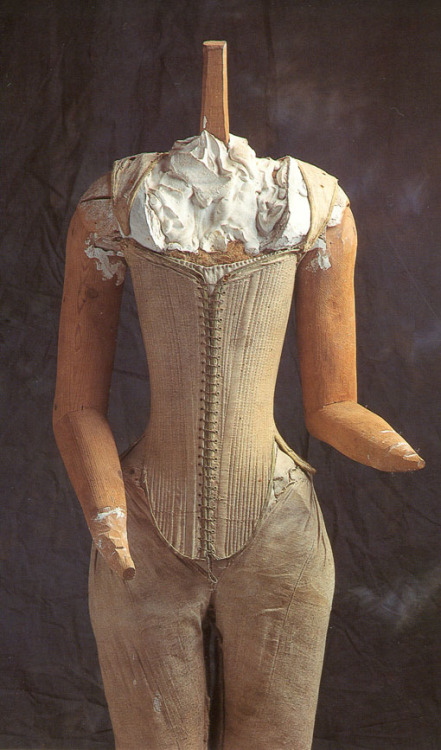 The Effigy Corset. This corset was taken from the Effigy of Elizabeth at Westminster Abbey for examination and study of the Queen's effigy. The edges of the corset are lined with fine leather that originally was apple-green. The corset itself was made of a fabric called fustian (a mixture of cotton and linen) and is woven in a twill pattern.
The reason for why the corset is in such a good condition is that is was not worn by a living woman - instead it was used for the effigy of Elizabeth after her death; that is a statue-like likeness of the Queen that was dressed as she would have been dressed when she was alive. If she had worn it the corset would probably have been in a worse condition because it would have been exposed to sweat and movement through its use.
These silk stockings belonged to Queen Elizabeth and are embroidered at the top. The Queen was fond of embroidered stockings and shoes - preferably made of silk. This particular pair of stockings was a Christmas present to the Queen from Robert Dudley and was given to her during the first New Year's celebrations of her reign.The boots (to the right) also belonged to Queen Elizabeth and was used by the Queen when she went hunting. The boots are made of leather and shows how thin her calves were.
The reason for why the corset is in such a good condition is that is was not worn by a living woman - instead it was used for the effigy of Elizabeth after her death; that is a statue-like likeness of the Queen that was dressed as she would have been dressed when she was alive. If she had worn it the corset would probably have been in a worse condition because it would have been exposed to sweat and movement through its use.
Subscribe to:
Posts (Atom)