 This might not be a piece of jewellery in itself but it is the sketch of a pendant by Holbein. It consists of the initials of Henry VIII (H) and Jane Seymour (I) - at the time there was no difference between a "J" and an "I". There are four gemstones set on the golden based pendant: two might be carnelians, one an emerald and one an onyx. Hanging from the pendant are three large pearls. From the drawing it seems that the pendant was supposed to be worn hanging from a ribbon rather than a metal chain.
Showing posts with label jewels. Show all posts
Showing posts with label jewels. Show all posts
Friday, 30 August 2013
Henry & Jane's Pendant
This might not be a piece of jewellery in itself but it is the sketch of a pendant by Holbein. It consists of the initials of Henry VIII (H) and Jane Seymour (I) - at the time there was no difference between a "J" and an "I". There are four gemstones set on the golden based pendant: two might be carnelians, one an emerald and one an onyx. Hanging from the pendant are three large pearls. From the drawing it seems that the pendant was supposed to be worn hanging from a ribbon rather than a metal chain.

Saturday, 29 June 2013
Jane Seymour's Necklace
The only official portrait of Jane Seymour shows her wearing a massive necklace in gold. The chain itself consists of four pearls (two by two) interrupted with golden ouches adorned with what appears to be onyxes. The same pattern is used for her neckline at the bodice. The pendant is as large as could be expected and looks a bit like Elizabeth's in her portrait painted when she was a young girl. The base of the pendant is gold which has two stones on it. The upper one is red but it is not a ruby but a carnelian - a ruby is generally shinier than a carnelian. The other stone is a large black onyx. To finish it all, a large drop pearl hangs from the pendant.

 |
| Replica found at www.tudorjewels.com |
Chains of Office
The Chains of Office or Livery Collar were used as signs of status during the Tudor times. The chains were heavy with an equally heavy - and large - pendant hanging from it. The chain itself would hang from shoulder to shoulder compared to a normal necklace.
Throughout his reign Henry VIII only gave out 20 chains (a small number compared to the King's otherwise infamous love of luxury) and as such they would only be given to the most trusted and faithful servants. The most famous of the chains is the Chain of Esses; one was found for the very first time in the house of Samuel Taylor Coleridge (poet). It belonged to Edward Montagu who was Lord Chief Justice of Henry VIII in the 1540's. The chain has been given its name from the double S's that makes up the chain; it stands for "Spiritus Sanctus" meaning Holy Spirit. It was common that a Tudor-rose would be hanging from the chain.
Throughout his reign Henry VIII only gave out 20 chains (a small number compared to the King's otherwise infamous love of luxury) and as such they would only be given to the most trusted and faithful servants. The most famous of the chains is the Chain of Esses; one was found for the very first time in the house of Samuel Taylor Coleridge (poet). It belonged to Edward Montagu who was Lord Chief Justice of Henry VIII in the 1540's. The chain has been given its name from the double S's that makes up the chain; it stands for "Spiritus Sanctus" meaning Holy Spirit. It was common that a Tudor-rose would be hanging from the chain.
 |
| Thomas More (by Hans Holbein) can be seen wearing the large chain of esses with a Tudor-rose pendant |
 |
| Replica of another version of the Chain of Esses |
Thursday, 6 June 2013
Anne Boleyn's "B"- Necklace
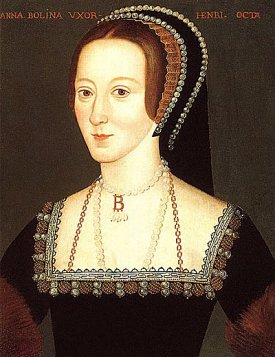 |
| The most famous portrait of Anne Boleyn in which she is wearing her signature necklace |
 |
| It is difficult to see but the young Elizabeth is wearing a necklace with the letter "A" on it - almost certainly the one her mother left her |
Saturday, 27 April 2013
The King's Jewels
As a renaissance monarch - with a huge ego - Henry VIII had to have the very best. This included his jewels which were considered among his most personal belongings. When the King travelled from palace to palace his jewels went with him; they were transported in coffers. This English King was infamous for his love of jewellery but that was not necessarily a bad thing - during the renaissance a King's wealth was supposed to be displayed in any means possible. It was even said that Henry VIII had more jewels than most other princes in Europe!
But Henry was also known to lavishly bestow large jewels on his wives - at least when they enjoyed his good-will! For example, Henry VIII gave Anne Boleyn a jewel that coat 15.000 crowns.
It was custom for the King to have jewels sewn into his clothes as well as using gold or silver thread. When an inventory was drawn up for the belongings of Henry VIII in 1547 it showed that the King owned no less than 3690 precious gemstones.
Sadly, none of Henry VIII's jewels has been identified as the belonging of the Tudor King. The only piece of jewellery actually worn by Henry VIII which look we can be certain of, is his crown. It was destroyed by Oliver Cromwell when he took over government but ever since then a replica has been created following descriptions from the Tudor age. It is unknown whether the crown was commissioned by Henry VII or Henry VIII but we do know that Henry VIII wore it on certain occasions.
The crown first appeared on an inventory from 1521. And of course, it was extravagantly executed. The gold alone weighed 3,4 kilos! To embellish the crown 58 rubies, 28 diamonds, 19 sapphires, 2 emeralds and 168 pearls were used. A recently discovered mural of Henry VIII shows the King wearing the Tudor crown. The crown was passed on to the King's children and was used for the coronations of Edward VI, Mary I, Elizabeth I, James I and Charles I. It appeared that Henry VIII actually had the crowned remodelled when he was created Head of the Church of England - he replaced three small kings with three equally small figures of Jesus Christ.
Since no original jewels survive we have to look to other methods to know of the King's jewels looked. There is probably no better option than that of looking at the many portraits of the King in which he wears some of his vast collection. So, these are some of the jewels that appear in portraits of Henry VIII:
But Henry was also known to lavishly bestow large jewels on his wives - at least when they enjoyed his good-will! For example, Henry VIII gave Anne Boleyn a jewel that coat 15.000 crowns.
It was custom for the King to have jewels sewn into his clothes as well as using gold or silver thread. When an inventory was drawn up for the belongings of Henry VIII in 1547 it showed that the King owned no less than 3690 precious gemstones.
 |
| Replica of the Tudor crown |
The crown first appeared on an inventory from 1521. And of course, it was extravagantly executed. The gold alone weighed 3,4 kilos! To embellish the crown 58 rubies, 28 diamonds, 19 sapphires, 2 emeralds and 168 pearls were used. A recently discovered mural of Henry VIII shows the King wearing the Tudor crown. The crown was passed on to the King's children and was used for the coronations of Edward VI, Mary I, Elizabeth I, James I and Charles I. It appeared that Henry VIII actually had the crowned remodelled when he was created Head of the Church of England - he replaced three small kings with three equally small figures of Jesus Christ.
Since no original jewels survive we have to look to other methods to know of the King's jewels looked. There is probably no better option than that of looking at the many portraits of the King in which he wears some of his vast collection. So, these are some of the jewels that appear in portraits of Henry VIII:
.png) |
| Gold necklace with gold pendant and onyx stone - portrait of Hans Holbein the Younger |
.png) |
| Another portrait by Hans Holbein the Younger - the King is wearing a chain of golden pendants with either rubies or onyxes linked with four lines of pearls |
.png) |
| The upper necklace is of a rather thick gold chain and centres around an onyx. The chain beneath it is rather strange compared to the normal style at the time. It would seem to consist of gold, rubies, small onyxes and a single, large pearl. |
.png) |
| Henry wore this on a portrait from the time when he was married to Catherine of Aragon. The overall expression is more cheerful than some of the more sombre ensembles. |
.png) |
| This brooch was pinned on a black hat |
.png) |
| This brooch is from a portrait of an ageing Henry VIII. It looks like a lot of metal-work has gone into decorating the gold. |
.png) |
| These ouches or brooches were pinned on the waistcoat |
Wednesday, 3 April 2013
Princess' Pearls

Pearls were the favourite accessory of Elizabeth I - a fondness that apparently started early as we can see on this painting of Elizabeth while she was still a princess.
The largest brooch at the edge of her bodice has a golden base with what appears to be an onyx in a cross cut-out. Three large drop-pearls hangs down from the three lowest edges of the square. The smaller pendant has a ruby and an onyx on a golden base - notice how the ruby matches the gown and the hood.
Just beneath this pendant another three large pearls hangs but these are much closer together than those at the larger brooch. The ouches of the bodice hem (also of a golden base) matches the black onyx stones. Keeping it all together is a long necklace of pure pearls.
 |
| Close-up |
 |
| This is a replica of the minor pendant - in this replica there is a diamond imitation instead of an onyx (can be bought at: http://www.pewterreplicas.com/detail.asp?id=154&selcurrencies=GBP) |
Subscribe to:
Posts (Atom)