Showing posts with label great-memorable-events. Show all posts

Saturday, 14 September 2013

The Marian Persecutions

"The Marian Persecutions" were the series of religious persecutions that took place after Mary I had become Queen of England. The persecutions began in January 1555 when Mary I had turned England's religion back to Catholicism - both the Council and the Parliament sanctioned the persecutions though some of their members went into exile. Still the the infamous laws of heresy and papal authority were issued and they were to cause many people the most painful death imaginable.

However, the persecutions were not popular with the Spanish Charles V despite the general believe that it was Mary's Spanish marriage that had brought about the religious intolerance; Charles V had experienced himself how unpopular persecutions were (I wonder why) and perhaps he was worried that it would jeopardize Mary's throne. But as it happened Mary's husband, Philip of Spain, did not share this hesitation. There were three groups besides the Queen herself that worked the great machinery of the counter-revolution (according to a Spanish account):

  • The Papal group - headed by Reginald Pole - whose loyalty was firmly placed with the Holy Father in Rome
  • English Romanists who were angry about how Henry VIII had treated the Catholics during the Reformation and therefore harboured a special grudge against the reformers
  • King Consort Philip and the Spaniards who had accompanied him to England. They needed to strike down as much as the reformist power as possible to strengthen Philip's personal authority 

Since that the persecutions did not take off before after Mary and Philip's marriage it would seem that it was the Spanish entourage of the King Consort who had sparked the beginning of the persecutions. Though the English Romanists were the most eager to persecute Protestants they could not do so without the consent of their monarch and her husband.

Stephen Gardiner was the main architect behind the string of religious fear that was about to hit England again. Like Mary, he had remained an ardent Catholic through the Reformation and definitely had an interest in turning the country back to what he saw as "the one and true faith".
One of the great "villains" in the Marian Persecutions were Edmund Bonner, Bishop of London. He had been reinstalled into his office at Mary's ascending to the throne. The reason for why he has stood out among all those who either sanctioned or carried out the persecutions is the disturbingly high number of people who were sent to the stake by him. One third of all the victims of the Marian Persecutions (that is about 100 people!) were burned within Edmund Bonner's diocese which meant that he had had to at least know about the arrests and at worst had eagerly taken part of them. In Foxe's "Acts and Monuments" he damns "Bloody Bonner" - not "Bloody Mary" - and tells of one interrogation performed by Bonner himself against a man named Tomkins. Tomkins refused to recant anything which in the end brought Bonner to the point of rage where he grapped Tomkins' hand and held it over a candle till the skin began to blister. The Spanish Ambassador also mentions this story so there is probably truth to the matter.

Mary herself also had her reasons for wanting to restore Catholicism to England though they might be of a more personal nature. It is not difficult to believe that Mary connected Catholicism with her mother and the happy period before the Reformation - perhaps she sought to regain some of that happiness. Some has said that the persecutions were not the work of Mary 1 herself but that of the people surrounding her and perhaps that is the case. It is also possible that Mary's believe that a wife should be obedient towards her husband in everything can have caused her to support him. Personally, I think that Mary was not just a strong woman but also a very determined and intelligent one who ardently believed that her people would be saved by returning to Catholicism but that she chose the completely wrong way to go about this - and that this decision was influenced by those around her. In December of 1554 (before the Spanish marriage that is) she stated this to her Council:
None may be burnt without some of the Council's presence and good sermons at the same.
According to British Express the Marian Persecutions differ from every other series of persecutions in England's history because it had no political background. Instead it was all about religious beliefs and not really an attempt to strengthen Mary's position as Queen. Also, the Marian Persecutions are by far the ones that feature the horrible death of being burned alive at the stake - it had never happened as frequently nor would again than during this time which just added to the terror. It should also be remembered that though Mary I is generally stated to have had about 300 (288 to be exact) people killed during her reign this is "just" during the persecutions - this number does NOT count the ones executed after the Wyatt Rebellion for example which counted for another 200. The fact that all these executions took place within two years (the persecutions ended in 1557) is most likely one of the main reasons for why this period is remembered as being so bloody.

Fifty of these 288 were burned at Smithfield in London. Whenever these executions took place the air is reported to have been so thick with the smell of burning flesh that most people could not go outside. A series of these executions were scheduled to take place on 17 November 1558 but they were interrupted in the very last moment by a messenger carrying the message: the Queen is dead. So, these Protestants saved their lives due to the fact that English law requires all death penalties signed by the monarch itself but that the execution is cancelled if the monarch dies before the sentence is carried out.

The executions of the Oxford Martyrs during the persecutions

BBC's list of the martyrs burned by Mary (link)

Sunday, 8 September 2013

The Arrest and Execution of Cromwell

Ever since the disastrous and short-lived marriage of Henry VIII to Anne of Cleves, Cromwell's place in the royal favour seemed wavering and Henry VIII did nothing to settle matters. After having given Cromwell the cold shoulder he made him Earl of Essex in April 1540. But Cromwell was far from safe despite his newest elevation.

On Saturday 10th June 1540 Thomas Cromwell was in the middle of a Council meeting when he was suddenly interrupted at around 3 o'clock in the afternoon. Every single one of his most powerful enemies watched when the Royal Guards marched into the room; Cromwell of course immediately understood what was happening and reputedly threw down his hat on the table - a sign of anger or one last frustrated gesture? To make the scene even more humiliating for the soon-to-be prisoner was that the Dukes of Norfolk and Southampton personally removed his chains of office from his shoulders before the Captain of the Royal Guard took hold of him. While he was leaving the room the other Council members began accusing him of treason. Thus Cromwell was escorted through Westminster and down to an awaiting barge ready to take him to the Tower of London.

In the end there was to be no trial for the ever hard-working Thomas Cromwell nor any chance for him to plead his case. On 29th June an Act of Attainder with Cromwell's name was drawn up and just like that he was found guilty in heresy and treason. It is interesting that Cromwell was not blamed for the terrible marriage of Henry VIII and Anne of Cleves (the marriage was not yet dissolved) nor how the King had chosen his policies. Instead Cromwell's main accusation was that of heresy, this accusation was the brainchild of the Catholic Duke of Norfolk and the embittered Catholic bishops that Cromwell had swiftly removed from their offices. Together, they managed to convince Henry VIII that Cromwell was not only spreading heretical messages himself but also openly supported heretics going as far as to even release them from prison and then taking care of their enemies. Also, Cromwell was condemned for corruption through the sale of licenses and pass-ports to people not approved of by the King. Lastly, Cromwell was accused of wishing to marry Lady Mary Tudor which would make him an immediate threat to the King's personal position because Cromwell would then have a claim on the throne through his wife.

While awaiting his fate within the Tower of London Cromwell wrote two letters to Henry VIII both fervently protesting his innocence. None was answered.
Then on 28th July 1540 Cromwell was taken from his cell to the Tower Green where he faced the scaffold. He was to be given a private execution but it can be safe to say that none of his previous enemies were there to watch the spectacle - they had all rushed off to watch the King marry Katherine Howard on the same day. It was his recently granted title that probably saved Cromwell from being either hanged, drawn and quartered or burned alive at the stake: as a nobleman he could be beheaded for treason. But no matter what Cromwell died an innocent man since no real evidence could be held against him besides what was openly planted by his enemies.

As Thomas Cromwell stood on the scaffold he apologised if he had ever displeased or defied God or the King. Interestingly enough he also mentioned that he would die in the Catholic faith - could this be an indication that he was threatened into saying so or perhaps even tortured? It has been suggested by Hall's Chronicle of Tudor England that the execution was made even more painful for Cromwell because his executioner failed to strike his head off with one blow but hacked away at his skull and shoulders until the head finally came off. Considering that inexperienced executioners was a very real part of Tudor England (as Mary, Queen of Scots would also come to now) this might actually be true. However, there is no evidence to support that Cromwell's enemies had made the executioner drunk before performing his duty. So, in the end this was how Thomas Cromwell met his fate. His head was boiled and placed on a spike on the London Bridge as was customary when dealing with traitors - as a last mockery his head was turned away from London city itself so that not even his now dead eyes could gaze upon the city.

Henry VIII would very soon afterwards come to regret this execution of what he called his "most faithful servant".

Cromwell's execution on "the Tudors"

Wednesday, 17 July 2013

Wedding of Mary I and Philip of Spain

Mary I had chosen to marry Philip of Spain despite the obvious resentment from both court and people. Their wedding took place on July 25 1554 within the Winchester Cathedral - it happened to be the celebration day for St. James, patron Saint of Spain. Mary was 37 at the time of her wedding while her bridegroom was ten years younger.

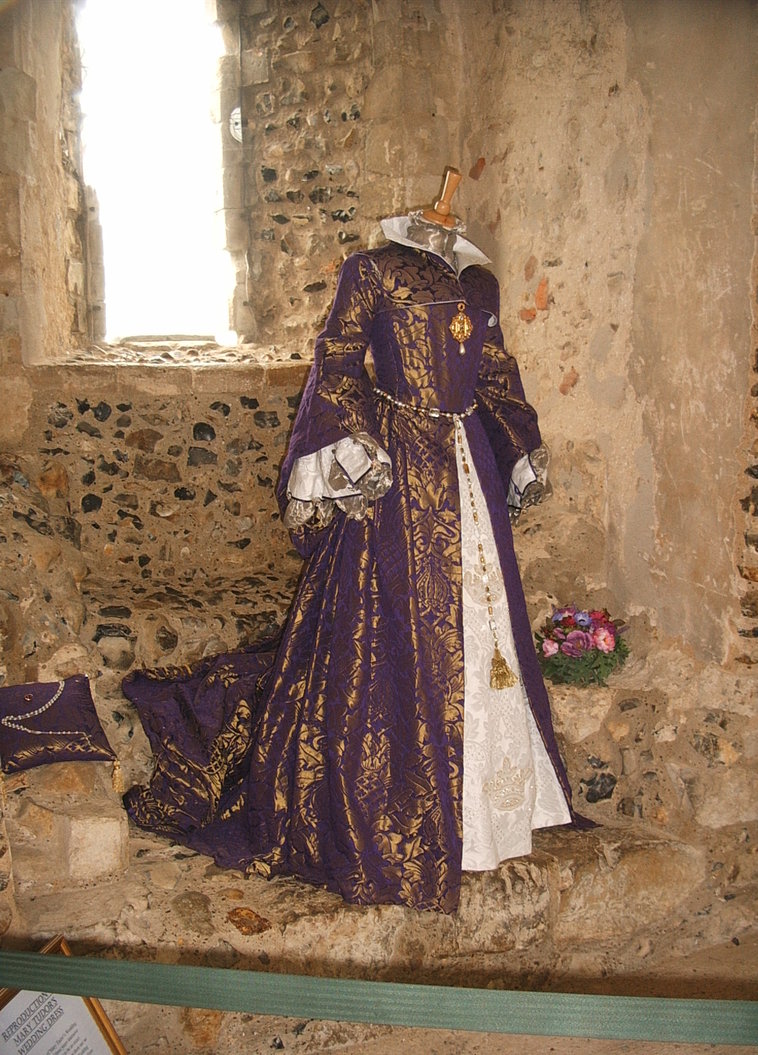
Mary had spent enormous amounts of time on her wedding dress which was in royal purple and gold; she had even had her soon-to-be husband's outfit sewn as while but his was in white and gold and embroidered. The cathedral itself was richly hung with cloth-of-gold and a scaffold had been erected in the middle (though for a more joyous occasion this time). Behing this stage two chairs had been produced: one for the bride and one for the bridegroom.
The prince entered first under a canopy with Spain's arms on it and then came the Queen accompanied by a large number of noblemen. Her train was carried by the Marquise of Winchester and the ceremonial sword by the Earl of Derby. The service was performed by the bishop of Winchester who was also Mary's Lord Chancellor. Besides him the bishops of London, Ely, Duresme, Chichester and Lincoln were present. It must have seem necessary to underline that Mary was not marrying a mere prince of Spain but also the King of Naples and Jerusalem because the bishop of Winchester held a short speech on the matter. Strangely enough it was Mary who sat on the right side during the ceremony and not her male counterpart - this was a clear signal that it was she who was the ruling monarch and not her Spanish co-regent.

The ceremony was said in both English and Latin (perhaps a compromise?) and then the Marquise of Winchester and the Earls of Pembroke, Bedford and Derby stepped forth to give away the Queen - after all she had no father to give her away and it was symbolically that the entire realm gave her away. After the ceremony the newly wedded couple attended Mass before the great altar. When the rings were securely placed and the treaty signed the congregation all rose and shouted out in happiness, beseeching God to give them joy through this union.

If you want to read a contemporary account of this mayor event (I used it for this post) then follow this link
This is a replica of Mary's wedding gown
Winchester Cathedral where the event took place

The Execution of Anne Askew

Anne Askew had been arrested for heresy and was tortured in the Tower which in itself was unusual since the law forbade the usage of the rack on women. Little did that help poor Anne. Eventually she was found guilty and sentenced to be burned at the stake - it must have frightened the Protestants at Henry's court since it was a clear sign of yet another turn on the King's religious path.

On 16 July 1546 a crowd was gathering at Smithfield near the church of St. Bartholomew. Anne herself was carried to the place of execution because her legs had been crushed during her interrogations. Here she was offered a pardon from the King but she refused saying: "I would rather die than break my faith". She was then lifted onto a small chair which had been attached to the thick pole in the middle of the stake since she could not even stand. After placing the tortured woman on the chair the executioner hung a small bag of gunpowder around her neck (but from whom?) in the hope that her death would not be drawn out for too long.
Then a torch was brought to the stake and ignited the faggots piled up around her. Accounts from those who witnessed the execution were all stunned by Anne's extreme courage and self-control. It is reported that she did not scream until the flames reached her chest and by then it would only be a matter of seconds before the gunpowder exploded. Some of these accounts were smuggled out of England and soon made their ways through Europe.

The execution of Anne Askew was not just meant as a punishment for refusing to obey the King's order. It was also a warning to the present Queen Catherine Parr. This last Queen of Henry's was known to be an ardent Protestant and Stephen Gardiner had succeeded in making Henry suspicious enough to make a move against his otherwise beloved wife. Even tough the royal palace was no where near Smithfield the flames of Anne Askew's final moments echoed in the royal halls.


Friday, 7 June 2013

Coronation of Edward VI

On February 20 1547 Prince Edward Tudor was crowned King of England in Westminster Abbey - at nine years of age. Edward's clothes were made of cloth-of-silver which had been embroidered with gold. Beneath this was white velvet adorned with rubies, pearls and diamonds.
The boy king-to-be rode on horseback through London to Westminster Abbey and on his way he was met with plays and masques. It is said that the royal procession was stopped along the way and Edward was given a purse of 1000 pounds to which the boy asked "Why do they give me this?". Edward was in particular amused by a Spanish entertainer who played with robes. It was the first time ever than the pageants on the road to Westminster Abbey had expressed an opinion as to what the new King's policy should aim at: one of the pageants involved players meant to embody England's desire for Edward to continue the reformation.
Some of the expenses of the account of the Revels' states:
"newe making and altering of Sundry maskes, and garments for players agenste the Coronacion of our soveraigne lorde Edward the Sixth"
Even the new King took part of the plays! According to "The Drama of Coronation" there are no surviving texts that tells us exactly what the plays were about but we do have one rather clear lead: cardinals, popes and kings were all a part of the play. The ceremonies that usually followed such an event had been shortened because Edward was so young and it was feared that he would be too tired before seeing it all. This meant that the celebrations lasted seven hours instead of twelve as was custom. All in all the procession to Westminster Abbey had taken four hours.

As Edward made his way to the raised dais on which he would be crowned, he was escorted by a bishop (most like Thomas Cranmer) and a lay magnate. He was carried around in a "litill cheyre" (little chair) by four gentleman ushers before Thomas Cranmer presented him to the waiting congregation.
Thomas Cranmer performed the ceremony (ever since the Boleyn family raised him to an Archbishop, he had been a symbol of Protestantism in England). But there was something different about this coronation which was first and foremost because of the strong desire of Edward Seymour (Lord Protector) and the young boy himself to complete the Protestant reformation. One of the changes was the meaning of the anointing oil - before adding it, Thomas Cranmer proclaimed "the oil, if added, is but a ceremony". Hereby the ceremony has lost its religious meaning and had become nothing else but a ceremony. Besides, Edward was the first King to be crowned as Head of the Church of England. His oath and the Recognition was edited as well to fit with the new regime.


This is an extract of Cranmer's speech at the coronation itself:
"Most dread and royal sovereign: the promises your highness hath made here, at your coronation, to forsake the devil and all his works, are not to be taken in the bishop of Rome’s sense, when you commit anything distasteful to that see, to hit your majesty in the teeth, as Pope Paul the Third, late bishop of Rome, sent to your royal father, saying, ‘Didst thou not promise, at our permission of thy coronation, to forsake the devil and all his works, and dost thou turn to heresy? For the breach of this thy promise, knowest thou not, that it is in our power to dispose of the sword and sceptre to whom we please?’ We, your majesty’s clergy, do humbly conceive that this promise reacheth not at your highness’  sword, spiritual or temporal, or in the least at your highness’ swaying the sceptre  of this your dominion, as you and your predecessors have had them from God. Neither could your ancestors lawfully resign up their crowns to the bishop of Rome or to his legates, according to their ancient oaths then taken upon that  ceremony."
At the end of the coronation the congregation (consisting of the lords and ladies of England) answered Cranmer's proclamation of Edward as the rightful King with: "Yea, yea, yea, God Save King Edwarde, God Save King Edwarde, King Edwarde."
When the coronation ceremony was over, the newly crowned King went to Westminster Hall for the great feast that was to follow. In his diary Edward wrote that he sat at the high-table with Edward Seymour and Thomas Cranmer "with the crown on his head". During this celebration a man named Edward Dymoke made the traditional display of loyalty by proclaiming that he would fight anyone who questioned Edward's right as King.


Thursday, 6 June 2013

The Execution of Mary, Queen of Scots

On the night of February 7, 1587 at Fortheringhay Castle Mary Stuart was informed that she had been found guilty in treason and was to die the next die. Having received the news, Mary wrote a letter to her brother-in-law King Henri of France.
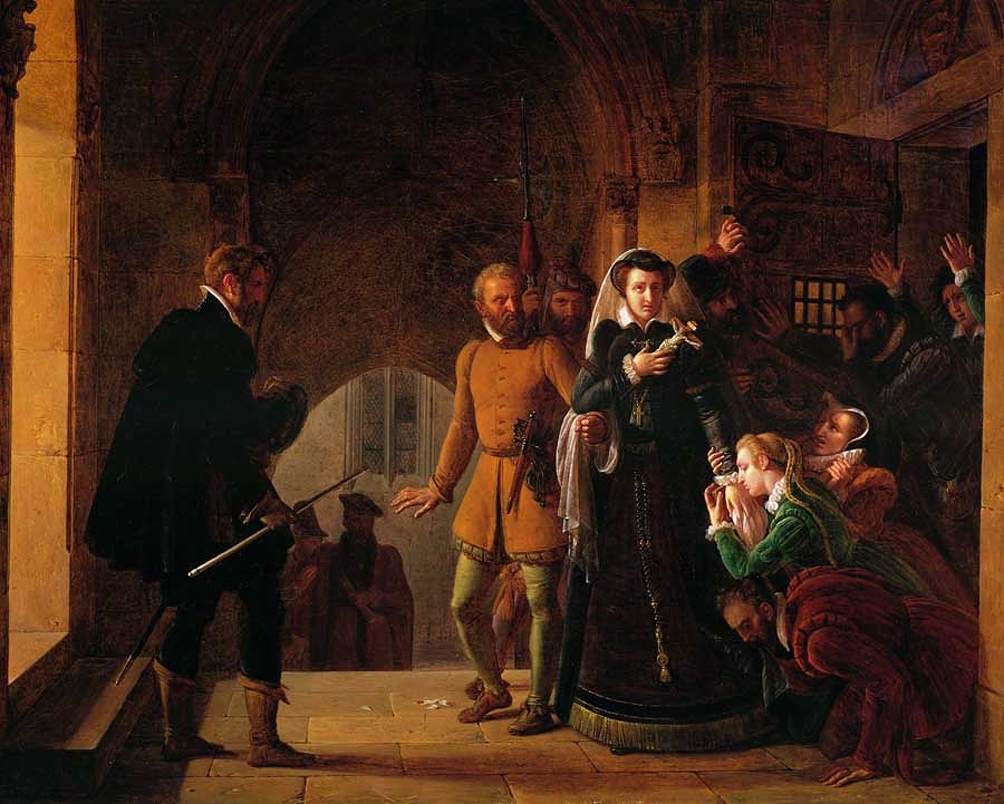
She was woken around 8 in the morning on February 8 and taken to the great hall of the castle where she was to be executed. The dethroned Scottish Queen wore a long black cloak as she entered the hall. But Mary had not performed her last act of drama yet: when she removed the cloak, she revealed a scarlet dress. Red is the colour of martyrs in Catholicism and by wearing this particular colour she made it clear to all the spectators that she considered herself a martyr for her beliefs. After ridding herself of her cloak, she kissed a crucifix.
Mary, Queen of Scots then knelled before the block where she was blindfolded. The executioner cut off her head with two blows from his axe and then held up her severed head saying: "Such end all the Queen's and the Gospel's enemies". It was at this moment that one of Mary's small lapdogs was discovered underneath her skirt, covered in its mistress' blood. Her body was buried in Peterborough Cathedral where it would remain until her son, James I of Scotland, had her moved to Westminster Abbey.

The following is an account of the execution by Robert Wynkfielde:
"Her [Mary queen of Scots] prayers being ended, the executioners, kneeling, desired her Grace to forgive them her death: who answered, 'I forgive you with all my heart, for now, I hope, you shall make an end of all my troubles.'  Then they, with her two women, helping her up, began to disrobe her of her apparel: then she, laying her crucifix upon the stool, one of the executioners took from her neck the Agnus Dei, which she, laying hands off it, gave to one of her women, and told the executioner he should be answered money for it.  Then she suffered them, with her two women, to disrobe her of her chain of pomander beads and all other her apparel most willingly, and with joy rather than sorrow, helped to make unready herself, putting on a pair of sleeves with her own hands which they had pulled off, and that with some haste, as if she had longed to be gone.
All this time they were pulling off her apparel, she never changed her countenance, but with smiling cheer she uttered these words, 'that she never had such grooms to make her unready, and that she never put off her clothes before such a company.'
Then she, being stripped of all her apparel saving her petticoat and kirtle, her two women beholding her made great lamentation, and crying and crossing themselves prayed in Latin.  She, turning herself to them, embracing them, said these words in French, 'Ne crie vous, j'ay prome pour vous', and so crossing and kissing them, bade them pray for her and rejoice and not weep, for that now they should see an end of all their mistress's troubles.
Then she, with a smiling countenance, turning to her men servants, as Melvin and the rest, standing upon a bench nigh the scaffold, who sometime weeping, sometime crying out aloud, and continually crossing themselves, prayed in Latin, crossing them with her hand bade them farewell, and wishing them to pray for her even until the last hour.
This done, one of the women having a Corpus Christi cloth lapped up three-corner-ways, kissing it, put it over the Queen of Scots' face, and pinned it fast to the caule of her head.  Then the two women departed from her, and she kneeling down upon the cushion most resolutely, and without any token or fear of death, she spake aloud this Psalm in Latin, In Te Domine confido, non confundar in eternam, etc.  Then, groping for the block, she laid down her head, putting her chin over the block with both her hands, which, holding there still, had been cut off had they not been espied.  Then lying upon the block most quietly, and stretching out her arms cried, In manus tuas, Domine, etc., three or four times.  Then she, lying very still upon the block, one of the executioners holding her slightly with one of his hands, she endured two strokes of the other executioner with an axe, she making very small noise or none at all, and not stirring any part of her from the place where she lay: and so the executioner cut off her head, saving one little gristle, which being cut asunder, he lift up her head to the view of all the assembly and bade God save the Queen.  Then, her dress of lawn falling from off her head, it appeared as grey as one of threescore and ten years old, polled very short, her face in a moment being so much altered from the form she had when she was alive, as few could remember her by her dead face.  Her lips stirred up and down a quarter of an hour after her head was cut off.
Then Mr Dean [Dr Fletcher, Dean of Peterborough] said with a loud voice, 'So perish all the Queen's enemies,' and afterwards the Earl of Kent came to the dead body, and standing over it, with a loud voice said, 'Such end of all the Queen's and the Gospel's enemies.'
Then one of the executioners, pulling off her garters, espied her little dog which was crept under her clothes, which could not be gotten forth but by force, yet afterward would not depart from the dead corpse, but came and lay between her head and her shoulders, which being imbrued with her blood was carried away and washed, as all things else were that had any blood was either burned or washed clean, and the executioners sent away with money for their fees, not having any one thing that belonged unto her.  And so, every man being commanded out of the hall, except the sheriff and his men, she was carried by them up into a great chamber lying ready for the surgeons to embalm her."
Here are some depictions of Mary, Queen of Scot's execution:


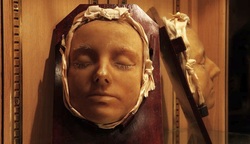
Death mask of Mary, Queen of Scots

Wednesday, 5 June 2013

The Nun of Kent

The Nun of Kent was known otherwise by her christening name of Elizabeth Barton. Her story is very unusual and it is easy to imagine why she drew so much attention to herself. She is believed to have been epileptic but the really strange thing about the servant girl was that she had been cured of some unknown - and therefore mysterious - condition. After her cure Elizabeth had periods of trances and visions during which she would predict the future - not the best qualities in a time that believed in witches!

Depiction of the hanging of the "Nun of Kent"
Such abilities were enough to make her famous in Kent where she lived; at first she would be known merely as the "Holy Maid of Kent" but when she entered a convent, her "title" was changed to "the Nun of Kent". Every single account of her describes her as being very well-liked and living a life that no one could find wrong in any way. Even when the King sent out clergymen to report on her were struck by her totally guiltless way of life. But then it all went wrong.
Elizabeth Barton was against the King's wish to divorce Catherine of Aragon and she made no attempt at hiding it. She even warned him that bad things would happen to him if he did not give up his great matter. She went so far as to write not to the King but to the Pope himself, telling him that his Holiness would be just as "cursed" as the King if he gave into Henry VIII's demands.

Attention had already been drawn to her earlier and now she was visited by several of the most powerful men in the country: King Henry VIII himself, Cardinal Wolsey, Archbishop Warham, Chancellor More and Bishop Fisher. None of them had found any flaws with her - that is, until she was asked about the divorce. In July 1533 Elizabeth Barton was arrested (on the order of Thomas Cromwell) and questioned by Cromwell himself as well as Thomas Cranmer. She was then put in a cell in the Tower. By November that same years a little show was put on to discourage her: she had to listen to a sermon in which she was publicly ridiculed and was ordered to confess that her entire career as a nun had been a fraud. Elizabeth herself did not confess but a confession was written in her name; however, it is far too sophisticated for a woman who had never had any real education.

At first it seemed that Elizabeth Barton was lucky: the King's judges refused to charge her with high treason because the case was simply too weak. Cromwell responded by drawing up a bill of attainder claiming that she was guilty, period. Thomas More and Bishop Fisher had also been arrested but both refused that the "Nun of Kent" had ever done anything to discredit herself. It did not matter in the end. Elizabeth Barton was hanged at Tyburn on April 20, 1534.

Thursday, 21 February 2013

Arrest of a Queen

When Anne Boleyn miscarried a second son, time was running out for the young Queen. She probably knew that something was happening since her husband was courting Jane Seymour in public and rumours started circulating. When her friend, Mark Smeaton, was arrested and tortured, Anne knew that fate had turned against her.

The remarkable thing about Anne Boleyn's arrest was the manner in which it happened and the cold way in which her husband arranged it. Anne was attending the yearly May Day Joust on May 2 when her husband received news - it was most likely the confession that Mark Smeaton had given after being tortured. He then invited Sir Henry Norris to walk with him and thus the King left the celebration - and Anne.
Previously her brother, George Boleyn, had been arrested but it had been done in such a discreet manner that the Queen did not even know about - if she had known she would have known that she was next.

However, Anne Boleyn was still ignorant of the dangers she faced when she received a message that demanded her presence in front of the Privy Council immediately. The Queen had been watching a tennis match as a part of the May Day celebrations. Anne left the tournaments and made her way to the council room where she found herself face to face with what looked like a jury: the Duke of Norfolk (Anne's uncle), Sir William Fitzwilliam and Sir William Paulet. She was informed that she was accused of adultery with no less than three different men and that Mark Smeaton had already confessed. Anne - always quick in wit - stood her ground and refused to acknowledge any of the accusations - but it did not work. She was sent to her rooms where she was to wait until the tides of the River Thames could take her away.

At 2 o'clock that afternoon, Anne Boleyn was escorted down to an awaiting barge from where she was sailed to the Tower. And that was it - the reign of Anne Boleyn was over and the Queen would never come back.
Arrest of Anne Boleyn

Wednesday, 20 February 2013

Field of the Cloth of Gold

At the year of 1520 France was becoming a major power in Europe while England was still a minor player. The two leaders Francis I and Henry VIII were two young men of similar age and they both had the same wish: to out-shine the other. To make sure that none of the parties would be offended, everything was divided equally. Even the location was chosen with care: the meeting were to take place exactly at the edge of the English territory of Calais.

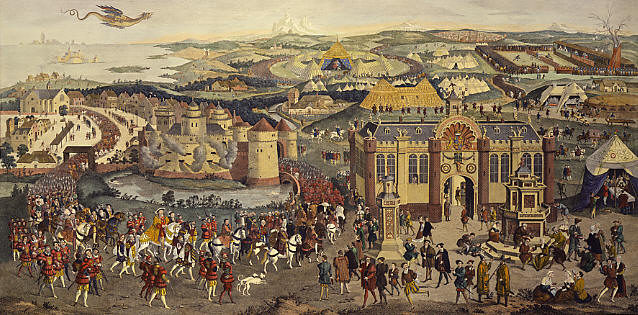
The Field of the Cloth of Gold as imagined by an artist in the
18th century.
Everything was arranged by Cardinal Wolsey. The idea was that the scenery of the meeting was to be a "camp" of tents of which each King was responsible for decorating and supplying. And the race for the best and most elaborate decoration was on. There was used so much Cloth of Gold (a very expensive fabric) in the construction of the tents and the costumes of hired actors and other entertainers that the meeting would be known as "the Field of the Cloth of Gold". Each part spared no means in showing what splendour their court was capable of presenting. Henry VIII brought with him a rather odd gift from the Ottoman sultan: two monkeys covered in gold leaf - these exotic animals was a source of great entertainment.

An entire palace (quickly erected and made of wood) of no less than 10.000 square metres (12.000 square yards) was build for the reception of the English King. But the palace was one big illusion - the only real solid thing was the brick base; the walls were cloth or tapestries hanging from wooden bars and were painted to look like bricks. And then there was the glass. Windows were expensive but the palace had been constructed with the usage of glass to give the visitors the impression that they were always outside.

The extravagance was endless: red wine flowed freely from two fountains and no less than 35 priests were employed at the chapel. Francis had called together the choir of the royal chapel which was famous for being one of the very best.

When two monarchs met, it required a lot of space and food to accommodate the huge entourages of the Kings. In just one month of the Field of the Cloth of Gold 2200 sheep were slaughtered for the two courts to eat. Guests of minor importance were housed in 2800 tents that had been erected at fields nearby.

When Henry VIII arrived on French soil on June 4, he settled into his main quarters at Guînes, while Francis I stayed at Ardres. Cardinal Wolsey - shining in the settings that he had organized - met with the French King. On June 7 the two Kings finally met at the Val d'Or. And then the entertainments could begin:
The numerous banquets and tournaments began and both Kings were eager to participate. They would also pay special attention to entertaining the Queen of the other King. Archery and wrestling was a part of the entertainment.
On June 24 Wolsey would say Mass and the two Kings would take leave of each other. Despite the elaborateness of the entire meeting, the following consequences were insignificant - Cardinal Wolsey would later arrange a treaty with Spain and Charles V who were the sworn enemies of the French.

Design of a tent that would be erected at the meeting