Showing posts with label jane-seymour. Show all posts

Monday, 25 March 2013

Queens' Rings


All can be bought here


A Palace of Queens

Yet another post of Hampton Court Palace! Some of the famous six wives of Henry VIII have left their mark on this favourite palace of their husband. So, let's take a look at the reminders of Queens that has been long lost to history.

This is the ceiling of the Anne Boleyn
Gateway - the squares that surronds
the Tudor rose involves Anne's falcon
The Anne Boleyn Gateway is now named after the doomed second wife of Henry VIII but it was not the case at the time - imagine the weirdness of that! After the downfall of Anne Boleyn, Henry VIII wanted to erase every memory of her and had her badges and initials removed. But a few were forgotten and today they serve as a reminder of the Queen that Henry wanted to forget. Anne's badges can still be seen at the Anne Boleyn Gateway which is also where the gateway derives its name. Also, her falcons and initials still adorns the great hammer-beams of the Great Hall's ceiling.

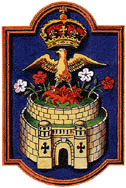
Jane Seymour's badge can be seen on an original frieze outside the Royal Chapel. Also the Great Watching Chamber still house references to this third wife. A phoenix rising from a castle can be seen on the ceiling of this room - the very badge of Jane.

Anne of Cleves is - despite her very short marriage - also among the wives that the castle can tell us about. In what is now a tea room a plate is displayed. This plate shows signs that it belonged to Edward VI - but the wheel of Cleves can still be seen on it. It is likely that the plate was hastily changed after the annulment of the couple's marriage.

Even Catherine of Aragon's pomegranate still remains - it hangs above a door frame, apparently forgotten.


Katherine Howard's ghost has put the "haunted" in the Haunted Gallery but since it is not a physical artifact I have chosen not to include it here.

Friday, 22 February 2013

Was Jane Seymour Henry VIII's Most Beloved Wife?

For many years it has been suspected that Henry VIII himself considered Jane Seymour his "true wife and Queen". Supporters of this theory points to two facts:
Henry had himself buried next to her and when he ordered a portrait painted of the Tudor dynasty so far, it was not the figure of his present wife, Catherine Parr, that appeared on the portrait next to him but Jane Seymour.

But was Jane the much-married King's favourite Queen and wife?

No, she probably was not. Before such a (well, rather drastic) statement is made it is important to look at the facts. Jane was the only wife that died before Henry VIII, whom he had not in some way already parted with. It is more likely that if Jane Seymour had lived after the birth - considering Henry's personality and marital past - she would eventually bore the King and he would tire of her.
And then there is the most vital thing in Henry's world: she gave him a son. For a man like Henry VIII this alone was enough to place her in a special position - but the affection probably did not stretch beyond the gender of their child. If Jane had died given birth to - yet another - girl then it would unlikely that Henry would ever have considered her the "love of his life".

So, it is likely that it was these two elements that made Jane Seymour as close to a perfect wife as possible: She had given him a son and then she had died at the height of his affection - before he could tire of her. But when you consider the way Tudor marriages worked, then there is a big difference between being a "good wife" and a "beloved wife". So far Jane had fulfilled her purpose as a good wife - but there is no evidence to support Henry's emotions towards his wife.

You just have to look to her predecessors to see the difference between Henry's (and the entire Tudor society) definition of a "good wife" and a "beloved" wife:
Catherine of Aragon was for almost 20 years a beloved wife of Henry VIII. Despite his adultery, he is said to have been genuinely loving her - until she "failed" in her job as a "good wife".

To be a "good wife" a woman had to be faithful, ever smiling and by his side and - most importantly - she had to give him a son. But after Catherine had had several stillborn sons and live sons who would quickly die, then she had not fulfilled the most important part of the Tudor period's version of a "good wife." And Henry's love began to fade.

When it comes to Anne Boleyn it is extremely unlikely that Henry was willing to get rid of a good and faithful wife, break with a church he believed in and turn half of Europe against him, for a woman he did not love. There is no reason to name all the proves of Henry VIII's love for Anne Boleyn but in the end she "failed" in the same task as her predecessor: she could not give him a son.

Did Queen Jane die from a C-section?

The greatest question that has surrounded the third wife of Henry VIII (and particularly her death) is whether or not a C-section was performed on Jane Seymour - and if so, did it kill her?

The death of Jane Seymour as imagined by
a later artist
When Jane Seymour went into labour it did not take long before the mid-wives knew that the birth would be long and very difficult. The poor Queen went through two days and three nights of labour before Prince Edward could be announced to the world. But ever since the birth ended - and especially after Jane died - rumours began circling, saying that a Caesarian section had been performed on the Queen.

It is therefore almost certain that there was no C-section performed on the Queen. A C-section was only performed on women who was either already dead during their labour. If it had only been this that spoke against a C-section for Jane Seymour then it would have been more likely. But the fact that Jane lived for twelve whole days after giving birth, makes it impossible. Due to the lack of knowledge of bacteria, anaesthesia and hygiene, there is no way that Jane would have survived such an extensive surgery.

However, the Queen may not have died of a C-section but she died of lack of care in her child bed. According to Antonia Fraser, Jane herself blamed her mid-wives and attendants when she realized that she was getting lethally weak. She would claim that they had not taken care of her in the right manner which resulted in her catching a cold and had failed to feed her what she needed. Besides, C-section, was prohibited by both the Catholic and Anglican Church. Whether Jane was right or not, it is widely accepted that she died of puerperal fever which was then known as "childbed-fever."  

Wednesday, 13 February 2013

Drawings of the Queens

I have come across these beautiful drawings of Henry VIII's wives and I thought that I might share them (I have arranged them to look nicer):


Jane Seymour's Phoenix


Like her predecessors - and successors - Jane Seymour had her own personal badge. The phoenix is not only the symbol of rebirth but also that of love. That Jane added it as the main figure to her badge was probably to show that Henry's love for her was a rebirth from his marriage to Anne - much like Anne Boleyn did before her. The fort represents a safe haven or a home - those exact things that Jane became known for.
Once again the red and white Tudor flowers that spring from the castle alongside the newborn phoenix symbolises the heirs that would spring from the safe home she would provide.

Monday, 11 February 2013

Jane Seymour's Ghost

Another ghost at Hampton Court Palace is that of Jane Seymour. She has been seen walking around the Clock Court and on the anniversary of the day that she gave birth to Edward VI, the former Queen's ghost is said to haunt the castle. Jane is said to ascend the stairs that leads to the Silver Stick Gallery, holding a candle in her hand and wearing a white gown. Some say that she is looking for her son whom she never got to see grow up.

According to legend, Jane is tormented with a heavy conscience and strong feelings of guilt over the part she played in Anne Boleyn's downfall. Therefore she will not find peace before Anne has forgiven her - something that apparently has not happened yet.


Saturday, 9 February 2013

Jane Seymour

Jane Seymour was born as the daughter of Sir John Seymour and Margery Wentworth. Not much is known of her childhood but she had not received a great education (she read and wrote a little but was better at household management and needlework) and was not nearly as intelligent as Catherine of Aragon or Anne Boleyn had been.
Jane Seymour served as a lady-in-waiting first to Queen Catherine and then to Queen Anne. It is possible that she had already been introduced as a lady-in-waiting to Catherine of Aragon in 1527. Jane is said to have had a "childlike face" and a modest personality. She probably had blond hair and is reported to be very pale and kind of nature.

Pleading Jane

The French ambassador who was stationed at the English court during Henry VIII's marriage to Jane Seymour has reported an incident that has gone remarkably unnoticed by. It is today a well-known fact that Henry and his third wife, Jane, disagreed on the question of the monasteries. Henry had by this time already closed many monasteries and it is reasonable to assume that he was not going to give it back; first of all he would be obliging a church he had left and secondly the monasteries had brought him considerable more wealth and power.
But Jane - otherwise described as ever obedient - threw herself at his feet when hearing of the fate of the monasteries. The incident took place in front of the whole court. She begged Henry to restore the monasteries but Henry retorted her and told her to get back on her feet. When she was standing again, Henry - loving as ever - reminded her that he had already told her several times not to meddle in his affair. And then the King sunk to a lower level by making a pointed allusion to what he called "the late Queen" - that being Anne Boleyn who had been executed a few months earlier.

Since then there has been no more reports of disobedience from Jane's side - she was probably terrified and with good reason. But it casts a new light on the image of a Jane that never said a word against her husband. After all, Henry said that he had told her "several times"; an indication that she had brought up the subject before.