Wednesday, 17 July 2013

The Execution of Anne Askew

Anne Askew had been arrested for heresy and was tortured in the Tower which in itself was unusual since the law forbade the usage of the rack on women. Little did that help poor Anne. Eventually she was found guilty and sentenced to be burned at the stake - it must have frightened the Protestants at Henry's court since it was a clear sign of yet another turn on the King's religious path.

On 16 July 1546 a crowd was gathering at Smithfield near the church of St. Bartholomew. Anne herself was carried to the place of execution because her legs had been crushed during her interrogations. Here she was offered a pardon from the King but she refused saying: "I would rather die than break my faith". She was then lifted onto a small chair which had been attached to the thick pole in the middle of the stake since she could not even stand. After placing the tortured woman on the chair the executioner hung a small bag of gunpowder around her neck (but from whom?) in the hope that her death would not be drawn out for too long.
Then a torch was brought to the stake and ignited the faggots piled up around her. Accounts from those who witnessed the execution were all stunned by Anne's extreme courage and self-control. It is reported that she did not scream until the flames reached her chest and by then it would only be a matter of seconds before the gunpowder exploded. Some of these accounts were smuggled out of England and soon made their ways through Europe.

The execution of Anne Askew was not just meant as a punishment for refusing to obey the King's order. It was also a warning to the present Queen Catherine Parr. This last Queen of Henry's was known to be an ardent Protestant and Stephen Gardiner had succeeded in making Henry suspicious enough to make a move against his otherwise beloved wife. Even tough the royal palace was no where near Smithfield the flames of Anne Askew's final moments echoed in the royal halls.


Untimely Play, Madam

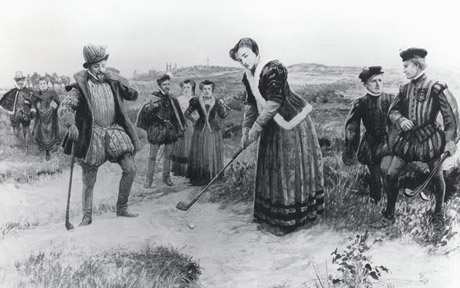
A romantic depiction of the Scottish
Queen playing golf
Mary, Queen of Scots was definitely a cause for many scandals in her time but there was one incident that not even her own supports could overlook. The thing was that Mary loved to play golf (and is generally believed to be the first woman in Scotland to do so) which seems harmless enough. She was taught the game during her time in France as Dauphine to the French throne and took it with her back to Scotland after her first husband's death - perhaps it had already arrived as a form of entertainment but sources are unclear on this. So where's the scandal?
When Mary's husband Lord Darnley was murdered in 1567 it was expected of the grieving widow that a proper amount of time would be spent in mourning. However, Mary went out and played her beloved golf just days after the murder! Even the Catholic church - which had so far supported Mary in everything - was outraged.
The "foul play" took place at Seton House; it is likely that it was here Mary lost to one of her ladies-in-waiting, Mary Seton. As a reward Mary gave her namesake a necklace which still survives to this day.

Legacy


Legacy

Susan Kay's "Legacy" follows Elizabeth I from her very first memory of the last time she saw her doomed mother, Anne Boleyn, to her own deathbed many years later. It is a fictional account but based on the actual events in her life - including the right details such as names and dates. I have read this book and everyone who loves anything Tudor should definitely dig into this one! It has everything you can ask for in a Tudor-book: accuracy, excitement, royal luxury and that ever-present danger.

Monday, 1 July 2013

Holbein Tags

These beautiful tags can be used for gifts and each pack consists of these three ladies (two of each): Lady Jane Rochford, Lady Radcliffe and Lady Suny. They are all based on drawings by Hans Holbein.

Can be found here

Saturday, 29 June 2013

Jousting Rules

This document was written on 12 February 1511 for a joust given by Henry VIII as a celebration for the birth of a son to the young King and Catherine of Aragon. The latter is even mentioned in the document as "Queen Noble Renown"  who was there when the tournament took place. She had sent four knights by the nicknames of "Ceure Loyall" (Sir Loyal), "Vailliaunt Desyre" (Valiant Desire), Bone Voloyor and "Joyous Panser" - the men behind these amusing nicknames were in fact Henry VIII himself (remember that he called himself "Sir Loyal Heart"), Sir Thomas Knyvet, Lord William Courtenay and Sir Edward Neville. The list also names several other courtiers who signed up for the challenge.

The tournament itself had all the typical grandiose luxury of Henry VIII. The fighting knights would arrive to the jousting place disguised as a moving forest with a castle of golden paper! Recordings from the Great Wardrobe shows that extravagant costumes were ordered. But the prince for whom this was all arranged would be dead by 10 days.

Hatfield House

Hatfield House as it stands today was completed in 1611 - that is after the death of Elizabeth I. But the old castle played an important part in the royal Tudor's life.
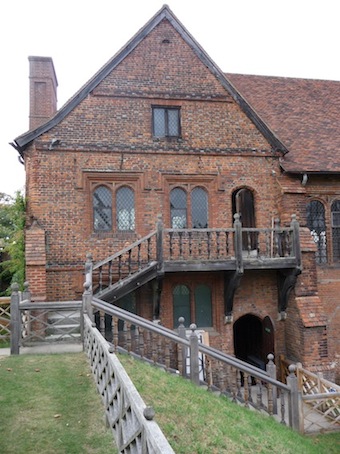
It was build in 1485 - the same year that Henry VII became King - by John Morton, the Bishop of Ely. The Banqueting Hall is the main remainder of the old palace.

It was one of the many houses owned by Henry VIII (he bought it in 1538) who used it to house Prince Edward, Princess Mary and Princess Elizabeth. But it was Elizabeth who has the greatest connection to the place. Her childhood there was happy and she would participate in her younger brother's education. However, when Mary I became Queen Hatfield House was transformed into a "country prison" for the threat that was Elizabeth. While staying there in 1558 she was informed that her sister had died and that she was now Queen of England.
The famous Rainbow Portrait of Elizabeth I is stored at this house and is one of the greatest examples of Tudor iconography. The portrait was painted when the Queen was in her later years but she appears as young as ever - it was to give the impression that she was immune to ageing. The text "Non Sine Sole Iris" means "No Rainbow Without the Sun"; the sun being Elizabeth which is another attempt at signifying her importance.


The Banqueting Hall - still as Elizabeth would have seen it
The Rainbow Portrait proudly on display in the Marble Hall

Jane Seymour's Necklace

The only official portrait of Jane Seymour shows her wearing a massive necklace in gold. The chain itself consists of four pearls (two by two) interrupted with golden ouches adorned with what appears to be onyxes. The same pattern is used for her neckline at the bodice. The pendant is as large as could be expected and looks a bit like Elizabeth's in her portrait painted when she was a young girl. The base of the pendant is gold which has two stones on it. The upper one is red but it is not a ruby but a carnelian - a ruby is generally shinier than a carnelian. The other stone is a large black onyx. To finish it all, a large drop pearl hangs from the pendant.

Replica found at www.tudorjewels.com

Chains of Office

The Chains of Office or Livery Collar were used as signs of status during the Tudor times. The chains were heavy with an equally heavy - and large - pendant hanging from it. The chain itself would hang from shoulder to shoulder compared to a normal necklace.
Throughout his reign Henry VIII only gave out 20 chains (a small number compared to the King's otherwise infamous love of luxury) and as such they would only be given to the most trusted and faithful servants. The most famous of the chains is the Chain of Esses; one was found for the very first time in the house of Samuel Taylor Coleridge (poet). It belonged to Edward Montagu who was Lord Chief Justice of Henry VIII in the 1540's. The chain has been given its name from the double S's that makes up the chain; it stands for "Spiritus Sanctus" meaning Holy Spirit. It was common that a Tudor-rose would be hanging from the chain.

Thomas More (by Hans Holbein) can be seen
wearing the large chain of esses with a Tudor-rose pendant
Replica of another version of the Chain of Esses

Inside the Body of Henry VIII

Sounds unpleasant, does it not? Nevertheless, the huge figure that Henry VIII acquired over the years has been a source of fascination for quite some time since historians and doctors think that the King''s health might have had something to do with his sudden change in personality. This is a link to an entire 45 minutes documentary on the subject (I am uploading different documentaries in time):

Inside the Body of Henry VIII - link 

The Royal Tudor Family

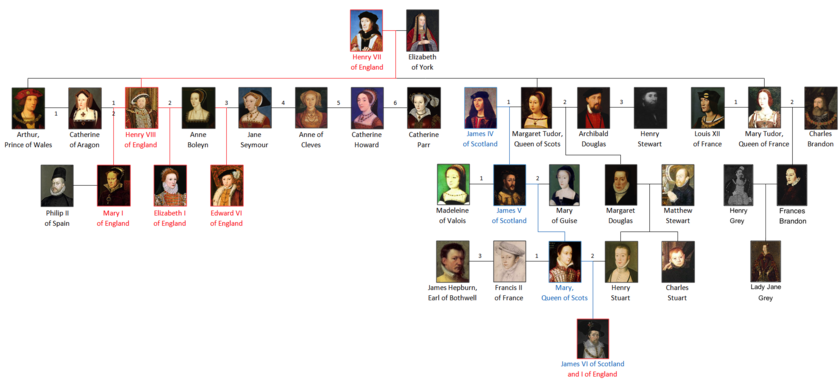
The Tudor family was not very large but sometimes it can be difficult to remember exactly how the different people were related. So, if you are ever wondering about questions such as: did Mary, Queen of Scots actually have a claim to the English Throne through her blood? Why was it decided that James VI should be James I of England? Then I found this lovely family tree (courtesy to wikipedia) that includes small portraits of them all:


If you have troubles making out what it says then here is the link: http://upload.wikimedia.org/wikipedia/commons/thumb/d/d7/House_of_Tudor.png/840px-House_of_Tudor.png 

The Cornish Rebellion

Henry VII was determined to fill the treasury to its limits and he succeeded. But in doing so he had to raise taxes which led to a rebellion in Cornwall in 1497. It was Michael Joseph (An Gof) and Thomas Flamank - who was a blacksmith and a lawyer respectively - who eventually took the lead. In May they led a 15.000 man army towards Devon and when they reached Wells they had gained an influential ally: the Baron Audley.

But the militia had not expected to meet no resistance whatsoever from the King's side and they began to realize that they could not push the King aside with the relatively small army. So, Thomas Flamank suggested that they sought support in Kent since several rebellions had started here. But the people of Kent was unwilling to aid the rebels and even enlisted in their Earl's armed forces against him. And that was not the only misunderstanding made in the rebel camp. Henry VII had not sat quietly with his hands in his lap (did he ever?) but had called back 8000 soldiers back from his war with Scotland. Meanwhile the royal family had moved to the security of the Tower of London. The citizens armed themselves and prepared to defend their King.
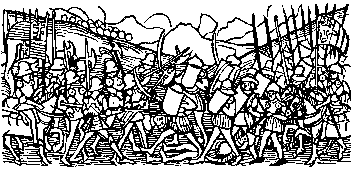
Simple drawing of the Battle of Blackheath

Henry VII sent out 500 men armed with spears on June 14 which seems to have been too much for the Cornish rebels to handle at once. They retreated to Blackheath where they would set up their last camp. Despite good leadership from Michael Joseph, some of the rebels were terrified as they lay up on a hill, looking down towards the Thames and some choose to desert. This would reduce the army to 9-10000.
The final battle was to be at Blackheath itself (though the battle is also referred to as the Battle of Deptford Bridge) and took place on June 17, 1497. By then Henry VII had gathered 25.000 men including cavalry - the elite soldiers of the day. Lords Oxford, Surrey and Essex led the three battalions and the rebels surrendered that same day.One of the great mistakes of the rebels was to fail sending support to the archers positioned at the crossing of the river Deptford Strand and another was to simply release Lord Dauberny when they actually managed to catch him. It is estimated that between 200-2000 rebels died.

The King's Wrath
Michael Joseph (An Gof) gave the final word to surrender and then fled to Greenwich but was caught. Both Baron Audley and Thomas Flamank were caught on the battlefield itself. Now the time had come to face Henry VII's vengance. Some prisoners were sold into slavery while Michael Joseph and Thomas Flamank was sentenced to death - at first they were to be hanged, drawn and quartered but some sources claims that they were "merely" hanged and then their bodies were dismembered. Their executions took place on June 27, 1497 at Tyburn while Lord Audley (being a part of the nobility) was beheaded within the Tower the next day.

Thursday, 27 June 2013

Killing a Lawyer

Thomas Flamank was a lawyer who became a prominent figure in the Cornish Rebellion of 1497 when the people rose up against Henry VII's continuous demand for tax money. However, the rebellion was struck down and Thomas Flamank was captured on the battlefield. From there he was led to London in chains on June 26, 1497. He was condemned to die the next day.
As a commoner, Thomas Flamank could not expect a swift beheading. The original sentence was that he was to be hanged, drawn and quartered but some sources claim that the King changed the sentence to hanging - the body would be quartered after Flamank's death. Whether or not the sentence was altered is not entirely certain but Flamank's head still ended on a spike on London Bridge.

A statue of Thomas Flamank
and another Cornish rebel
leader

The End of Two Tax Collectors

Richard Empson and Edmund Dudley worked for Henry VII performing a job just as unpopular then as it is know: tax collecting. Henry VII was determined to refill the treasury and managed to do so but not without the help of his hated tax collectors. But despite public opinion the two remained safe until Henry VII died.

After just a couple of days after the old monarch's death the newly crowned Henry VIII decided to do something to soothe the ill-will of his subjects. Consequently, Richard Empson and Edmund Dudley were brought before a jury and demanded to explain their aggressive methods. But the case was tricky. It had to be carried out without disgracing Henry VII but at the same time making it clear that they were actually guilty of treason. They were both convicted for treason (on the grounds of a royal warrant, not a bill of attainder) and sentenced to be beheaded in 1510 on Tower Hill.

And here we have the trio: Henry VII (centre),
Richard Empson (left) and Edmund Dudley (right)

Joan Boughton's Painful End

Joan Boughton was tried for heresy and sentenced to be burned at the stake; the sentence was carried out on April 28, 1485 (according to Fox's Book of Martyrs). One of the things that had gotten Joan in the ever-paranoid view of the Church was the following statement claiming that:
"she was soo beloved with God and his angelys that all the ffyre in London would not hurt her."
She had also made the "mistake" of openly supporting the doctrines of Wickliffe whom the Catholic Church saw as an increasing threat. The Catholic Church had tried to convince Joan that she could be offered a pardon if she would admit her errors but the elderly lady refused - and paid for it with her life.
Joan Boughton was no less than 80 years old when she was taken to her place of execution at Smithfield which means that she would have been born in 1395. The surprising thing about this case is not that she was given such a hard penalty (burning was the standard execution method for female heretics) but that Joan Boughton was not a nobody. She had considerable influence and status. According to the London Chronicle her ashes were gathered and placed in a pot that would become known as a "precious relic".

Friday, 7 June 2013

Coronation of Edward VI

On February 20 1547 Prince Edward Tudor was crowned King of England in Westminster Abbey - at nine years of age. Edward's clothes were made of cloth-of-silver which had been embroidered with gold. Beneath this was white velvet adorned with rubies, pearls and diamonds.
The boy king-to-be rode on horseback through London to Westminster Abbey and on his way he was met with plays and masques. It is said that the royal procession was stopped along the way and Edward was given a purse of 1000 pounds to which the boy asked "Why do they give me this?". Edward was in particular amused by a Spanish entertainer who played with robes. It was the first time ever than the pageants on the road to Westminster Abbey had expressed an opinion as to what the new King's policy should aim at: one of the pageants involved players meant to embody England's desire for Edward to continue the reformation.
Some of the expenses of the account of the Revels' states:
"newe making and altering of Sundry maskes, and garments for players agenste the Coronacion of our soveraigne lorde Edward the Sixth"
Even the new King took part of the plays! According to "The Drama of Coronation" there are no surviving texts that tells us exactly what the plays were about but we do have one rather clear lead: cardinals, popes and kings were all a part of the play. The ceremonies that usually followed such an event had been shortened because Edward was so young and it was feared that he would be too tired before seeing it all. This meant that the celebrations lasted seven hours instead of twelve as was custom. All in all the procession to Westminster Abbey had taken four hours.

As Edward made his way to the raised dais on which he would be crowned, he was escorted by a bishop (most like Thomas Cranmer) and a lay magnate. He was carried around in a "litill cheyre" (little chair) by four gentleman ushers before Thomas Cranmer presented him to the waiting congregation.
Thomas Cranmer performed the ceremony (ever since the Boleyn family raised him to an Archbishop, he had been a symbol of Protestantism in England). But there was something different about this coronation which was first and foremost because of the strong desire of Edward Seymour (Lord Protector) and the young boy himself to complete the Protestant reformation. One of the changes was the meaning of the anointing oil - before adding it, Thomas Cranmer proclaimed "the oil, if added, is but a ceremony". Hereby the ceremony has lost its religious meaning and had become nothing else but a ceremony. Besides, Edward was the first King to be crowned as Head of the Church of England. His oath and the Recognition was edited as well to fit with the new regime.


This is an extract of Cranmer's speech at the coronation itself:
"Most dread and royal sovereign: the promises your highness hath made here, at your coronation, to forsake the devil and all his works, are not to be taken in the bishop of Rome’s sense, when you commit anything distasteful to that see, to hit your majesty in the teeth, as Pope Paul the Third, late bishop of Rome, sent to your royal father, saying, ‘Didst thou not promise, at our permission of thy coronation, to forsake the devil and all his works, and dost thou turn to heresy? For the breach of this thy promise, knowest thou not, that it is in our power to dispose of the sword and sceptre to whom we please?’ We, your majesty’s clergy, do humbly conceive that this promise reacheth not at your highness’  sword, spiritual or temporal, or in the least at your highness’ swaying the sceptre  of this your dominion, as you and your predecessors have had them from God. Neither could your ancestors lawfully resign up their crowns to the bishop of Rome or to his legates, according to their ancient oaths then taken upon that  ceremony."
At the end of the coronation the congregation (consisting of the lords and ladies of England) answered Cranmer's proclamation of Edward as the rightful King with: "Yea, yea, yea, God Save King Edwarde, God Save King Edwarde, King Edwarde."
When the coronation ceremony was over, the newly crowned King went to Westminster Hall for the great feast that was to follow. In his diary Edward wrote that he sat at the high-table with Edward Seymour and Thomas Cranmer "with the crown on his head". During this celebration a man named Edward Dymoke made the traditional display of loyalty by proclaiming that he would fight anyone who questioned Edward's right as King.





Thursday, 6 June 2013

House of Percy

The House of Percy descends from William de Percy who came to England from France in 1067. Apparently, he must have made an impression on William the Conqueror and was made baron of Topcliffe. William de Percy rebuilt York Castle in 1070 - previously to that the family name was derived from their castle in Normandy. Throughout the years the family gained influence and the titles of Earl or Duke of Northumberland (alongside that if Baron Percy) has been in the family for centuries.
Had it not been for the women in the family, the name would have died out because the male line died out twice - in both cases a Percy-lady's husband would adopt the name to keep it alive. The family produced countless of prominent gentlemen and ladies among which are:

Henry Percy, 2nd Earl of Northumberland - supported Henry VI but was killed at the beginning of the War of the Roses

Henry Percy, 6th Earl of Northumberland - was betrothed to Anne Boleyn

Sir Henry Percy - better known as Harry Hotspur

Henry Percy, 9th Earl of Northumberland - imprisoned after the Gunpowder Plot

Feeding a Court

When Cardinal Wolsey "handed over" Hampton Court Palace to Henry VIII, considerable changes were made to the kitchens' function even though the look remained largely the same as when Cardinal Wolsey occupied the palace. The King was always surrounded by courtiers and they expected to dine with their monarch as well; just about six hundred people took their place at the dinner table - twice each day! This meant that the original kitchens were not nearly enough and thus they were expanded to the extent of spanning 50 rooms. When this remodelling was done in 1529 the kitchen-area was 3000 square metres. Such a large amount of courtier required a large amount of servants; 200 people would work in the kitchen. So what did they eat during a normal year?

Elizabeth I's court consumed 1240 oxen, 8200 sheep, 2330 deer, 760 calves, 1870 pigs and 53 wild boars! But the monarch's own dinner was not prepared with the rest since the risk of poisoning was too great - imagine how easy it would be to poison one of the many dishes leaving the kitchens.

The kitchen-complex (conveniently located to the north so it does not receive the full heat of the sun) shows that Henry VIII's court was actually aware of the importance of keeping some level of hygiene. This resulted in the construction of several smaller kitchens within the kitchen-complex itself and each of them served their own purpose. Let's take a look:

  • The Boiling Room: meat
  • The Pastry Room: pies and pasties
  • The Confectionery: sweets (this was normally preserved the richest)
To this came the three larders to contain the ingredients (without a refrigerator, of course) and the three cellars for the enormous amount of alcohol that went with every meal:
  • The Flesh Larder: meat
  • The Dry Larder: grain and nuts
  • The Wet Larder: fish
  • The Wine Cellar with 300 casks of wine
  • The Great Cellar where no less than 600.000 gallons of ale was stored
  • The Privy Cellar which was only for the monarch's drinks
This huge meal required through organization. You could only get to the kitchens by passing a gatehouse where the Offerer and his assistants - with the strange name of Clerks of the Greencloth - kept a close eye on everything that came into the royal palace - including the members of staff! Explore the different aspect of the kitchen-complex to find out what happened in each room.
 

Great Kitchen

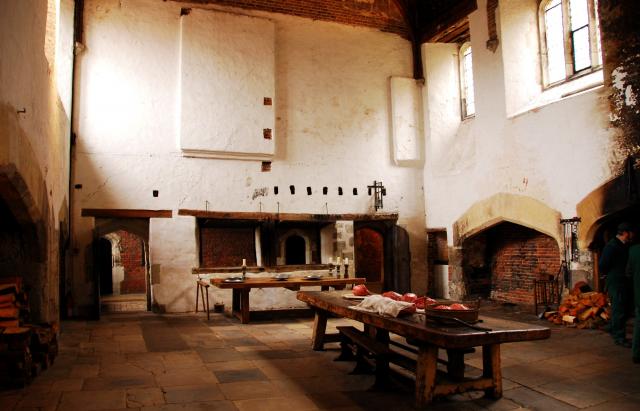
The Great Kitchen was the main room in the vast "kitchen apartments" and it was from here that the finishing touch would be added to the food. Originally the Great Kitchen had six open fireplaces with spit-racks but only one of them is still as it was when Henry VIII expected his dinner. At the rear of the hall waiters would bring the finished dishes to the Great Hall - the dishes would be delivered through hatches. Large parts of the Great Kitchen was finished in 1514 but was expanded when Henry VIII took over the palace.


This should give you an impression of how big the fireplaces are! 

The Children of Henry VIII


Alison Weir is the author behind this book about the three children of Henry VIII and his great-niece Lady Jane Grey.

Anne Boleyn's "B"- Necklace

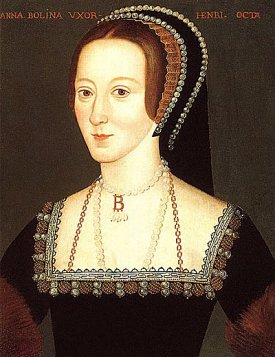
The most famous portrait of Anne Boleyn in
which she is wearing her signature necklace
If we are to judge from the few portraits of Anne Boleyn then her "B"- necklace must have been her favourite jewellery since it is featured in so many of them. Obviously, the "B" stands for Boleyn. After Anne had been executed the necklace (extraordinarily enough) passed on to her daughter, Elizabeth I, alongside another necklace of Anne's with the letters "AB" on it. During the Tudors it was common to wear jewellery with your initials on it, so Anne's necklace would not have been thought odd. As can be seen from the portrait the necklace consists of pearls with the golden "B"-pendant from which three large drop-pearls hangs.


It is difficult to see but the young Elizabeth is wearing a
necklace with the letter "A" on it - almost certainly the one
her mother left her