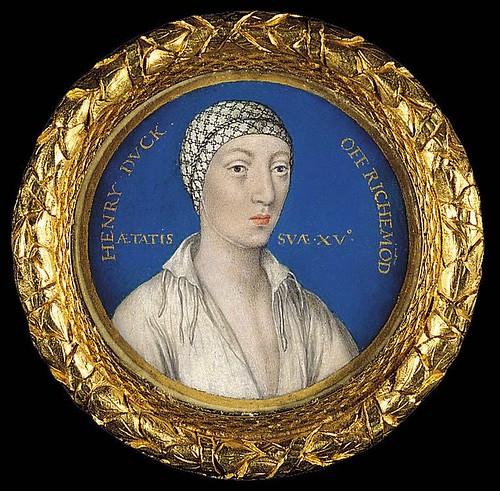
This portrait depicts Henry Fitzroy, the illegitimate son of Henry VIII and his mistress Bessie Blount. The portrait was painted between 1533-34; Henry would die approximately three years after (if the portrait was painted in 1533). Henry would have been 14-15 years old when the portrait was painted. The portrait is painted with water-colours by Lucas Horenbout - the portrait itself is quite small measuring just about 44 millimetres in diameter. It belongs to the Royal Collection of the British royal family and has done ever since it was bought by none other than Queen Victoria.
Stay in the Past
Showing posts with label painting-the-Tudors. Show all posts
Thursday, 9 May 2013
Wednesday, 20 February 2013
A Life Changing Portrait
This is the infamous portrait that would convince Henry VIII to marry Anne of Cleves. Hans Holbein was sent to Cleves to paint a likeness of the sisters Anne and Amelia of Cleves. When he returned the King adored the portrait of Anne of Cleves and consequently chose her as his fourth wife. But the King's adoration turned to disgust when she arrived for their wedding where he immediately proclaimed that he "liked her not" and that she looked like a horse.
If we are to judge by this picture - not regarding whether Holbein beautified it or not - Anne of Cleves was definitely not ugly - personally I think she is rather beautiful and looks like a very sweet person.
An Ageing Queen
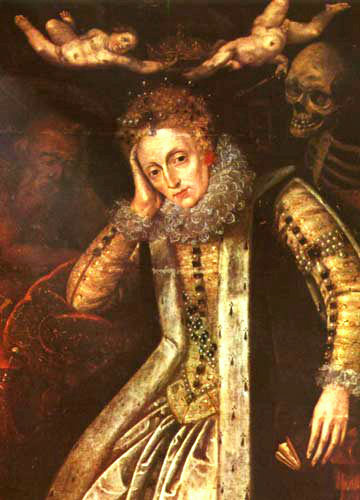
This is one of those rare portraits of Elizabeth I that depicts a woman who is no longer young - to say the least. At the end of her reign, the artists wanted to keep the illusion - for Elizabeth herself and her people - that she was a woman whom time could not affect. It is easy to imagine the Queen being angered by a portrait showing an old woman. This portrait is referred to as the "Allegorical Portrait" and is packed with symbolism.
The Queen is resting her tired head on her hand while two angels (or cherubs) are removing her heavy crown - finally taking a burden of her shoulders. To her right is a man with a long white beard: Father Time. Death is looking over her shoulder to her other side. Everything in this portrait is aimed at depicting the passage of time and that Elizabeth's time is running out.
The portrait was painted in around 1610 which is seven years after the Queen's death. Even if it had been painted when she was alive, it would probably never have been shown to the Queen - considering the notorious Tudor-temper it is likely that Elizabeth would have been less than pleased with it.
Wednesday, 13 February 2013
Confess!
Archbishop Cranmer tries to get Katherine Howard to confess her guilt and her offences against the King
The Ugly Truth?
This is an engraving of Henry VIII not longer before he died. When this was made the King was married to Catherine Parr. Does the picture show the truth? If that is the case then Holbein obviously beautified the ageing King in his last portraits of him
Tuesday, 12 February 2013
The Execution of a Would-be-Queen
This is probably the most famous portrait of Lady Jane Grey's execution after only nine days as Queen of England. It is obvious from the picture that the artist wanted to show her innocence which is seen in the completely white Lady Jane Grey.
A Weeping Queen
This painting shows Catherine of Aragon walking away crying while her husband (in the background) is talking - or most likely - flirting with Anne Boleyn.
Sunday, 10 February 2013
Anne Boleyn's last goodbye
Anne Boleyn says a final goodbye to her daughter Elizabeth before her execution. Painted by Gustaf Wappers in 1838. She is wearing her signature French hood and ermine trimmed sleeves as a symbol of royalty.
Subscribe to:
Posts (Atom)