Wednesday, 5 June 2013

The Nun of Kent

The Nun of Kent was known otherwise by her christening name of Elizabeth Barton. Her story is very unusual and it is easy to imagine why she drew so much attention to herself. She is believed to have been epileptic but the really strange thing about the servant girl was that she had been cured of some unknown - and therefore mysterious - condition. After her cure Elizabeth had periods of trances and visions during which she would predict the future - not the best qualities in a time that believed in witches!

Depiction of the hanging of the "Nun of Kent"
Such abilities were enough to make her famous in Kent where she lived; at first she would be known merely as the "Holy Maid of Kent" but when she entered a convent, her "title" was changed to "the Nun of Kent". Every single account of her describes her as being very well-liked and living a life that no one could find wrong in any way. Even when the King sent out clergymen to report on her were struck by her totally guiltless way of life. But then it all went wrong.
Elizabeth Barton was against the King's wish to divorce Catherine of Aragon and she made no attempt at hiding it. She even warned him that bad things would happen to him if he did not give up his great matter. She went so far as to write not to the King but to the Pope himself, telling him that his Holiness would be just as "cursed" as the King if he gave into Henry VIII's demands.

Attention had already been drawn to her earlier and now she was visited by several of the most powerful men in the country: King Henry VIII himself, Cardinal Wolsey, Archbishop Warham, Chancellor More and Bishop Fisher. None of them had found any flaws with her - that is, until she was asked about the divorce. In July 1533 Elizabeth Barton was arrested (on the order of Thomas Cromwell) and questioned by Cromwell himself as well as Thomas Cranmer. She was then put in a cell in the Tower. By November that same years a little show was put on to discourage her: she had to listen to a sermon in which she was publicly ridiculed and was ordered to confess that her entire career as a nun had been a fraud. Elizabeth herself did not confess but a confession was written in her name; however, it is far too sophisticated for a woman who had never had any real education.

At first it seemed that Elizabeth Barton was lucky: the King's judges refused to charge her with high treason because the case was simply too weak. Cromwell responded by drawing up a bill of attainder claiming that she was guilty, period. Thomas More and Bishop Fisher had also been arrested but both refused that the "Nun of Kent" had ever done anything to discredit herself. It did not matter in the end. Elizabeth Barton was hanged at Tyburn on April 20, 1534.

Tuesday, 4 June 2013

Faded Peach

Elizabeth I is portrayed by Helen Mirren in "Elizabeth I" from 2005 in this gown. The gown seems remarkably simple compared to what Elizabeth wore (not just in reality but also throughout this movie) but when you take a closer look, the luxury is definitely there. The main fabric is a faded peach-coloured velvet; on the skirt layers of golden transparent fabric has been added to give the dress a glittering effect. The petticoat is decorated with a floral pattern in soft green and beige on a cream background - it stand out compared to the simpleness of the peach-coloured fabric but with a certain elegance. Every edge has been trimmed with a light golden ribbon of satin which has been embroidered at the sleeves and sewn with buttons at the bodice. 
Across the bodice golden gemstones or glass pearls adds a glimpse of the extravagance the real Elizabeth loved so much. The upper part of the gown actually resembles a riding habit with the slightly puffed shoulders and the collar that is buttoned until the neck - hereby replacing the more common neckline. The lining of the gown is carefully embroidered as well with a golden tone On one side the flap is fastened with an impressive brooch shaped as a golden star  with a huge pearl hanging from the body of the brooch.

Monday, 3 June 2013

An Execution Gown?

Clémence Poésy plays Mary, Queen of Scots in "Gunpowder, Treason and Plot" in which she wears this gown. I haven't seen the movie yet but this looks like her execution scene and if that is the case then the dress is very historically incorrect since Mary wore a deep red dress for her execution. Anyway, this dress is made of a champagne/grey satin with a simple skirt that shows no petticoat whatsoever. The bodice is trimmed with an edge of cotton ribbon. There is a twist to it though - the bodice suddenly drops at the middle of the chest to reveal the same fabric as the bodice.
On each shoulder there is a roll with the same cotton ribbon as on the bodice. The collar is stiff and almost standing (its probably resting on the rolls). Notice that the sleeves are made of a different fabric than the rest of the gown though it is kept in the same colour: the sleeves are marked with white dots and has been trimmed with cotton ribbon.

Silver Meeting


Though Katherine Howard is normally associated with bright, feminine colours, this one is more subtle. Tamzin Merchant wears it as Katherine Howard on "the Tudors". The skirt and the petticoat are both rather simple (the petticoat being sewn with silver thread) but the main focus is definitely on the bodice. Even the sleeves are completely without any decorations. But let's take a closer look at that bodice. A beautiful mixture of embroiderings with thread and pearls makes the motive literally stand out from the otherwise completely flat form of the bodice. Frills of ivory pearls hangs from the bodice and drops down in front of the very top of the skirt. The white pearls are used on the bodice alone - probably to add some change to the usage of golden/beige thread. It is worth noticing that the bodice is made of velvet while the skirt is made of satin.
Close-up of the bodice

Green and White Presentation


Annabelle Wallis portrays Jane Seymour in "the Tudors" (in my opinion she was the best Jane by far). The dress is dominated by a clean white fabric decorated with green and white flowers. The puff-sleeves and the "over-skirt" are both of moss-green satin or silk unlike the bodice, sleeves and petticoat. The green colour used for the flowers perfectly match the moss-green parts.
Notice that the neckline has not been adorned with gemstones but with delicate white lace instead - the same lace also peaks out from under the edge of the sleeves. Instead of the gemstones a detailed necklace with green stones - of course - and golden chains. However, this dress is not a Tudor-gown.

Sunday, 2 June 2013

Dark Catherine

In "Anne of the Thousand Days" this costume was worn by Irene Papas as Catherine of Aragon at her trial. As it is often the case with Catherine's gowns this one is very dark. The bodice is completely simple without any decoration whatsoever - only the shine of the fabric has effect. The neck and collar bone are both covered in black muslin or organza. At the very edge the white linen shirt peaks out and creates a ruffle. The only thing of colour in this set are the golden stripes on the sleeves. A long and sleeveless "jacket" is worn in the trial scene but that does not have any colour either. A very large cross with dark onyxes on a golden base with three pearls dangling from the pendant - the chain itself is also of gold.

A Blue Catherine

Deborah Kerr portrays Catherine Parr in "Young Bess" from 1953 in which she wears this gown. The bodice, the sleeves and the skirt are all made from a silver damask with a blue/grey shine.The petticoat and the pieces above the neckline are black - an unusual colour since black was only worn when in mourning. The neckline of the bodice is adorned with silver and a dark gemstone - possibly sapphires or onyxes. The opening of the sleeves are lined with grey fur and gives way to black voluminous puffed sleeves with peaks of white linen. From the waist a simple kirtle in silver discreetly slim-lines the look.

A Golden King


Charles Laughton plays Henry VIII in "Young Bess" from 1953 in which he wears this costume. The main material is gold - golden fabrics in both terns and nearly paisley. The sleeves opens up to reveal the white linen shirt underneath. Also, several lines of different fabrics has been used to adorn the sleeves. However, the white satin band around the "majestic" waist is unusual - normally a belt would have been used. Notice the dagger hanging from the satin; it is also golden. The real Henry VIII had a fondness of fur (since it was a sign of wealth) and this attire follows that particular taste. Pieces of white/grey furs lines the cape that is otherwise kept in a slightly darker beige than the outfit.
The middle photo reveals 18 golden buttons - however these are not featured on the exhibition photo of the costume beneath. The look is topped off with the heavy golden chain with what appears to be pearls at the centre.

Saturday, 18 May 2013

Horrible Histories - the Tudors!

I love Horrible Histories and of course their Tudor-songs. Originally made for educational purposes (for children) it still sticks to the facts which makes them so great:

The Tudors' Song:


Mary Tudor Song:


Queen for Nine Days:


The Six Wives of Henry VIII:


A Tudor Feast

These four videos were created by BBC about the Tudor feasts! So if you ever wondered how Henry VIII went from being "the handsomest prince in Christendom" to the fat, old man we remember him as just take a look.

Part 1:


Part 2: http://www.youtube.com/watch?v=4SqPulHN4Jk
Part 3: http://www.youtube.com/watch?v=OVcv9bCRh9g
Part 4: http://www.youtube.com/watch?v=Lx24WNqFDxs


The Chapel

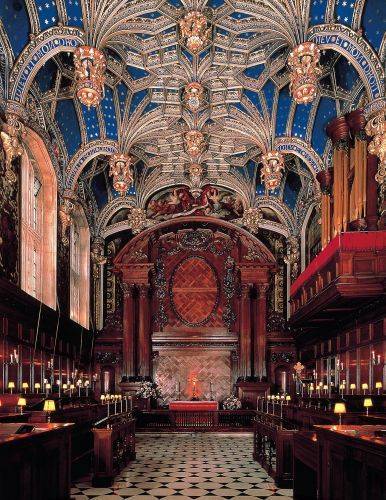
The Chapel at Hampton Court Palace has witnessed many important events during the Tudor time. Among other things, it was here that Archbishop Cranmer secretly handed Henry VIII a letter containing all the details of Katherine Howard's affairs. Prince Edward was baptized here shortly after his birth in 1537.

It was Cardinal Wolsey who had the Chapel extended to its current size. The extraordinary ceiling was added during the reign of Henry VIII in 1535. There are clear signs that the ceiling was built by a Tudor monarch. At the very top of the walls the red and white rose of the house of Tudor has been carved out as well as Margaret Beaufort's portcullis which Henry had chosen to take over after his grandmother's death. The large window of stained glass are rich on symbols: Henry VIII's patron saint - Saint Henry the Emperor - is joined by Saint Catherine, Saint Thomas Becket and Saint Anne. The royal family itself is also featured - Henry VIII, his wife and Cardinal Wolsey are kneeling in prayer. It was originally created for Wolsey by Erhard Schön of Nürnberg but he fell from favour before he could enjoy it. The monarch and his family would sit in the Royal Pew above the rest of the congregation.
It is strange that this church was not stripped of its rich décor during the Reformation.


One of the large stained glass windows (it might just be
Cardinal Wolsey at the top and Henry VIII in the middle)

Friday, 17 May 2013

Cardinal Wolsey's Apartments

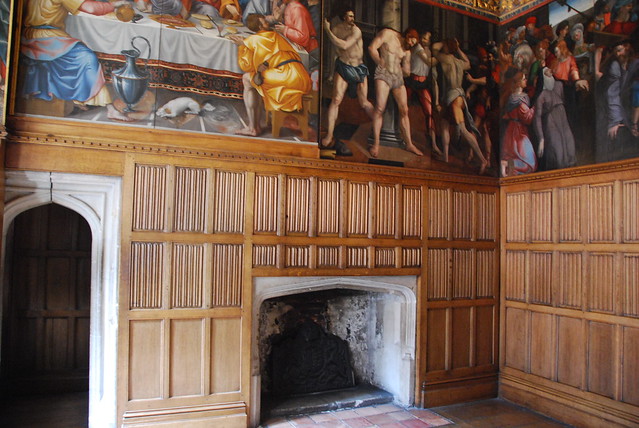
Despite that it was Cardinal Wolsey who turned Hampton Court Palace from a mansion to a palace there is just one room that remains as it was when he occupied it: Wolsey's Closet. This was one of the Cardinal's private rooms. Religious paintings of an unknown painter depicts "The Last Supper", "the Passion of Our Lord", "the Scourging at the Pillar", "the Carrying of the Cross" and "the Resurrection" - all very appropriate for a Cardinal but some sources claim that it was Henry VIII who commissioned them. The ceiling is extremely elaborately done with ornaments of Tudor roses and the feathers of the Prince of Wales. A rather large open fireplace guaranteed that the Cardinal would not be cold.
Next to Wolsey's Closet there is a small room which is thought to have been the Cardinal's wardrobe.


Detail of the ornaments on the ceilings 


Prince Edward's Lodgings

The rooms made for Prince Edward are some of the only parts that survived as it was when the long-longed for heir occupied the rooms; but sadly it was badly tarnished by a fire and now nothing remains of the original décor. It was completed in 1537 when Henry VIII decided to make entirely new rooms for Prince Edward; the rooms closed the Chapel Courtyard which had hitherto been opened. It was here that Edward would spent his early childhood surrounded by countless servants making sure that the precious heir would never be in want of anything. He had been christened in the chapel of Hampton Court Palace and  his chambers were never far from the chapel.

Façade of Prince Edward's lodgings 

King's Presence Chamber

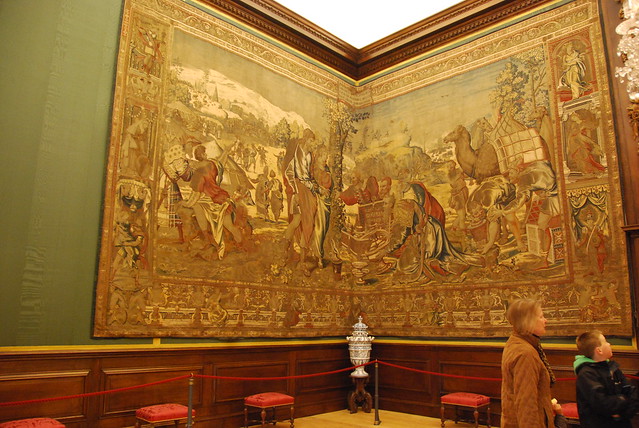
The King's Presence Chamber was only available to those who held the highest ranks and the King's favour. The dark wooden walls are covered in detailed tapestry - a part of Henry VIII's massive collection. One of the tapestries depicts the legend of St. George on horseback trampling over a dragon. Another depicts the "12 Labours of Hercules". Today, a crimson canopy hangs as the focus-point of the room - it is the original canopy from the time when William III occupied Hampton Court Palace; it still has the silver and golden embroideries at the centre to form a coat-of-arms. A portrait of William III is widely believed to be painted by James Hamilton who worked for James I during the reign of Elizabeth I.


Thursday, 16 May 2013

The Royal Pew

Cardinal Wolsey constructed the Royal Pew in the mid 1520's. At the back of the royal chapel a balcony marks a royal pew which was divided into two sections: one for Henry VIII and one for the Queen - whoever that might be at the time. It was from this location that the monarchs would attend religious services; Henry VIII sat here while Katherine Howard ran screaming down the Haunted Gallery, but the King was not moved by her shrieks.


Council Chamber

The Council Chamber was one of the very first rooms that Henry VIII added to Hampton Court Palace after he took over the palace. The room measures c. 4,8 (16 feet) metres in length and width and there are just about 3 metres (10 feet) to the ceiling. Because there are only three windows the room is not very well lit for most of the day - the only other source of light is the open fireplace. It was in this very room that many of the important decisions in Henry's reign were made.
The floor itself is colourful which was remarkably popular during the Tudors and has been decorated with a modernized Tudor rose. Today the room is hung with blue velvet and the King's throne is placed at the centre (of course) surrounded by a circle for the councillors.

Henry VIII's "throne"


Tuesday, 14 May 2013

Striking Gentlemen

The Tudor age was filled with great lords who constantly watched over their rivals. But sometimes even the most sofisticated men of England turns to more "medieval" ways.
The Privy Counsil's members were appointed by the King and thus a seat on the council was a great honour. An honour that - according the Henry Howard, Earl of Surrey - should not befall those without the right ancestry. Henry Howard was immensely proud of his aristocratic roots and firmly believed that "lesser men" such as Edward and Thomas Seymour were not worthy of such an honour because they had merely been admitted to the King's inner circle due to the King's marriage to their sister.

Edward Seymour

In 1537 records show that Henry Howard had been arrested and imprisoned at Windsor for striking Edward Seymour! The incident took place at the royal residence of Hampton Court Palace and there were strict rules as to what was allowed; an violence in this manner - and between gentlemen - was certainly not allowed. The penalty was severe for the punishment and were it not for Thomas Cromwell's intereference, Henry Howard would have lost his right hand! This would have made a military career impossible which was one of the things that Henry wanted the most.

But, apparently, Edward Seymour was proud as well and determined not to be spoken against. His power grew steadily - especially after the death of Jane Seymour - and in 1546 the episode happened again. This time it was Edward Seymour who hit Bishop Gardiner in the face during a meeting of the Privy Council! Bishop Gardiner was a part of the staunch opposition to the Protestant Seymours and that had eventually resulted in yet another public outbreak amongst the greatest men in England.

Thursday, 9 May 2013

The First Son To Live


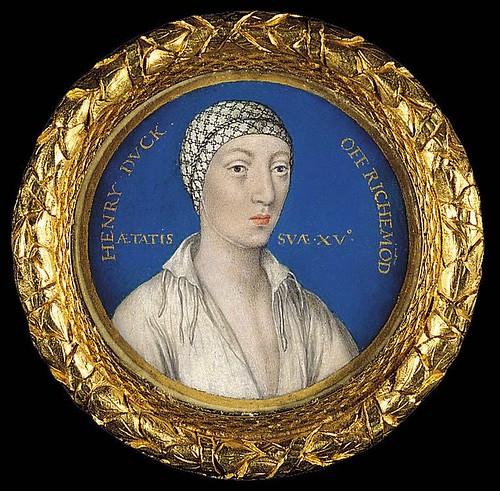
This portrait depicts Henry Fitzroy, the illegitimate son of Henry VIII and his mistress Bessie Blount. The portrait was painted between 1533-34; Henry would die approximately three years after (if the portrait was painted in 1533). Henry would have been 14-15 years old when the portrait was painted. The portrait is painted with water-colours by Lucas Horenbout - the portrait itself is quite small measuring just about 44 millimetres in diameter. It belongs to the Royal Collection of the British royal family and has done ever since it was bought by none other than Queen Victoria. 

Magnificent Teal, Colourful Coral


This dress is probably one of the most recognisable dresses from "Elizabeth"(1998) and was designed by Alexandra Byrne. The dress is based on a regular Tudor-gown but there has been added a little extra to the dress in the shape of the large coral shawl. The shawl has been sewn onto the left shoulder and at the seam of the bodice and the skirt to make it fall in a graceful curve. At the left shoulder it has been fastened with a large rosette which has been pleated several times to create drapery.
Strangely enough the gown does not show off the petticoat but is completely closed at the front - probably to keep the focus on the bright-coloured shawl. At the back the skirt has been pleated onto the bodice as well to add volume.
The teal silk sleeves gives way to a wide opening of teal fabric with dark, slim lines. The sleeve that appears from underneath these layers are beige and is decorated with pink and green flowers. White fabric has been laid in under the bodice (at the neckline) - dark green stitches forms a floral pattern all across the neckline. 

The bodice is made of teal velvet while the skirt is entirely made of silk. As it can be seen in the top picture the sleeve opening is made of a completely different fabric than the main sleeves - it looks as if the striped fabric is sort of tulle.

Soft Lavender


A young princess Elizabeth is portrayed by Lalla Ward in "the Prince and the Pauper" from 1977. It is rare to see such a soft lavender that has an almost metallic shine at the bodice. The sleeves has not been brimmed up but still reveals voluminous sleeves from her chemise. The wrists has been adorned with jewels - most likely pearls to match the neckline. The petticoat is based on the same colour as the rest of the gown but has been decorated with golden streaks.
The princess is wearing a necklace but the pendant is hidden by the bodice. However, the stones appears to be amethysts since they match so perfectly with the gown's colour.


The gown is topped with a beautiful French hood - once again it matches the gown. The hood is decorated with precious stones of a purple colour and golden embroideries. Notice the golden fabric just peeping put from under the hood.