Showing posts with label titillating-titbits. Show all posts

Friday, 13 September 2013

Henry VII & Elizabeth of York - a Happy Marriage?

Considering Henry VIII's "difficulties" in finding happiness in marriage it is worth to take a look at that of his parents. That Henry VII married Elizabeth of York to end the War of the Roses is a well-known fact but how did the two of them actually get along?

One of the best way to tell true affection is when you lose something. Henry VII was a very reserved man but there were two cases in particular were he could not hide his feelings: at the death of his son Arthur and that of his wife.
Arthur, Prince of Wales died in 1502 at Ludlow Castle. This threw both his parents into great mourning and it would seem that the couple relied on each other in this time of crisis. Henry is reported to have publicly shown great concern towards his Queen during this particular period. Elizabeth of York also attempted to help her husband through this. When Henry VII had gotten the news of Arthur's death he is said to have much struck by grief. Allegedly, Elizabeth tried to comfort her husband by reminding him that having only one son was no sign that their dynasty should not survive. After all he had been the only son of Margaret Beaufort but he had still survived to become King of England. And God had still left them with a very healthy son and two equally strong daughters.

When Elizabeth of York died in 1503 Henry was more inconsolable than ever. He is reported to have "privily departed to a solitary place and would no man should resort unto him". Elizabeth was given a magnificent funeral with no expense spared - considering Henry VII's great dislike of spending money on anything this is yet another sign of his affection for his Queen. Henry had her buried in the part of Westminster Abbey that he himself had had built (the Lady Chapel). In due time Henry would lie next to her again.
Despite having only one son and being now a widower Henry VII refused to marry again. Of course some inquiries were made including to the Dowager Queen of Naples but in the end Henry would not have Elizabeth replaced and he died a widower. Apparently, Elizabeth had been a calming factor on Henry's temper because after her death he grew more and more prone to depression and paranoia - something his surviving son, Henry VIII, would inherit.

The tomb of Henry VII and Elizabeth of York

Thursday, 12 September 2013

Epping Forest

Not only was Epping Forest one of the many hunting forests for the royal Tudors it also had a special and tragic connection to Henry VIII. When Henry VIII was chasing Anne Boleyn they visited this forest together and probably went riding there together. They stayed at the hunting lodge Poteles once.

Henry VIII was especially fond of Waltham Abbey where he would stay whenever he went hunting in Waltham Forest. We know that he set out from Greenwich to Waltham Abbey with both Catherine of Aragon and Anne Boleyn in May 1528. The next time Henry visited Waltham Abbey was in July 1529 but this time he was accompanied by Anne Boleyn alone - he also took her there on progress in 1532 during which they stayed for five days at the Abbey.

However, there is another more tragic connection to this doomed couple. In 1536 Henry VIII went to Epping Forest on May 19th. While he was staying here the sound of a canon being fired informed him that Anne Boleyn had been executed - the King was having his breakfast under the shade of a large tree. According to Moray's History of Essex the King cried out: "Away! Unkennel the dogs!" when he heard the bang.

Henry VIII hunting on the Morning of Anne Boleyn's Execution

Sunday, 1 September 2013

A Disturbing Found

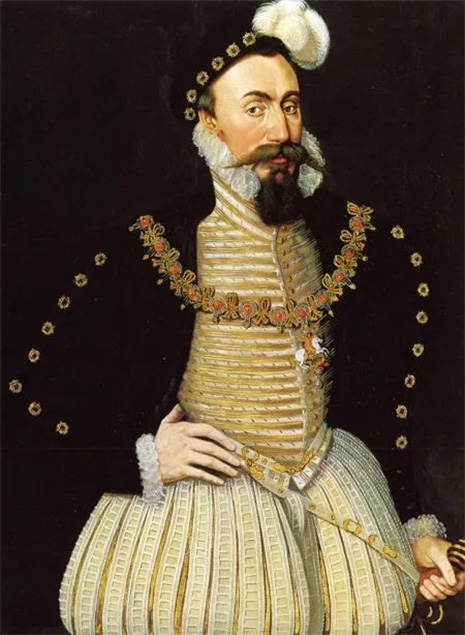
On 23 February 1554 Henry Grey, Duke of Suffolk was executed by an axeman on the order of Mary I. In 1851 (almost 300 years after his death) workmen were working in the Holy Trinity church in London when they discovered something that must have made them skip a heartbeat. In a vault the severed head of Henry Grey lay perfectly intact thanks to the thick sawdust - rich on tannin and from oak - that had been in the casket where the beheaded Lord's head fell for so long ago.
It is thought that the grieving widow of Henry Grey who had also lost her daughter just eleven days earlier had taken the head and quickly hidden it before it could be put on a spike on the London Bridge.

Henry Grey had actually bought the Holy Trinity church in the 1540's after Henry VIII had dissolved the monasteries so it is very likely that he was buried within the walls of his own property. The Holy Trinity church was completely destroyed during the German blitz during World War II. However, the head was not lost in the ruins. In 1899 the Holy Trinity church had been merged with another church, St. Botolph's-without-Aldgate and the head was transferred to this other church. Now it is placed somewhere within this church but its' exact location is unknown.

Henry Grey, Duke of Suffolk

Wednesday, 14 August 2013

The Tudors and their Trees

It may seem odd but there actually are a few connections between the Tudors and different trees. Let's take a look at how they are connected...

Queen Elizabeth oak, Northiam, East Sussex, UK, you might think this 1,000 year old tree is just a tree but it's a very special tree! When Queen Elizabeth I journeyed to Rye on August 1573 she sat under this tree and ate a meal. She changed her shoes of green damask silk with a 2 5" heel and pointed toe and left them behind as a memento of her visit. They are still in existence and are shown on special occasions. They are kept at Brickwall a Jacobean House in the villageThis tree is known as "the Queen Elizabeth Oak" and is located in Northiam, Sussex. Elizabeth I stayed here on her way to Rye in 1573 and decided to eat her meal in the shade of the oak. When she was done she left her shoes behind. These green damask shoes - with a heel of 2,5 inch - still exits and are exhibited at Brickwall House. The little plaque next to the tree informs visitors of the oak's royal past.

And it was under an oak tree that Elizabeth first heard the news that she was now Queen of England. The actual tree is long gone but Queen Elizabeth II herself planted a new tree on the exact spot of the old one to honour the memory of her namesake. The new (and old) oak tree was placed at Hatfield House where Elizabeth had been under house arrest. The to-be Queen was either eating an apple or reading when courtiers suddenly rushed to her side and bowed down to her. She then dropped gracefully to her knees herself - having risen at the sight of the courtiers - and made her famous quotation in Latin: "This is the Lord's doing and it is marvellous in our eyes."

Another little tidbit is about Elizabeth's doomed mother Anne Boleyn. Her ghost is said to appear at her childhood home Hever Castle in Kent where she roams around a large oak (perhaps a family favourite?). As it happens this was one of the trees under which Henry VIII courted Anne before their tragic marriage. Legend has it that the couple even danced around the tree. Despite this link to Anne Boleyn and Henry VIII the tree is also known as "the Queen Elizabeth Oak" (the names have been ground for confusion)

Wednesday, 3 April 2013

An Innocent Princess

Princess Mary - daughter of Henry VIII and Catherine of Aragon - was reputedly completely ignorant of any foul words or phrases. It has been reported that she did not know the word "whore" until she ascended to the throne - however this seem unlikely. After all, Mary did not life in a closely fitted bubble and foul words have probably found their ways to the innocent Princess' ears. It is more likely that she simply did not utter the bad words until she wore the crown herself.
For example she is known to have called a lady-in-waiting of hers a whore after the discovery of an intimate affair.

Wednesday, 20 March 2013

The Tudors & Baths

Well, we all know that the hygiene was lacking (to say the least) at the court of the Tudors. But it appears from recently discovered documents that the Tudors bathed and washed more than we have thought so far. So, let's take a look at some of the Tudors - who were the clean ones and who skipped their baths?

But strangely enough, Henry VIII defied the health advises from the doctors and bathed! At Hampton Court Palace (Bayne Tower) he had a large tub installed which was the height of what technology could do: it was heated by a stove in the room next door and the hot water was led from there to the King's tub. Henry's wound his leg was constantly aching and the King chose to bathe in a mixture of herbs and musk - attempting to ease the pain.
The King even went so far as to take herbal baths - except when the sweating sickness was out.

Mary, Queen of Scots was also fond of bathing. According to rumours the Scottish Queen liked to bathe in wine!

Also Elizabeth I bathed frequently compared to her courtiers. It is reported that the Queen bathed at least once every month - and to her contemporaries that was almost too much! The Queen's sharpened sense of smell might have contributed to the frequent baths but Elizabeth still joins the league of the "clean" Tudors!

But of course, not everyone followed these royal examples as you can see from the following examples:

Anne of Cleves followed German traditions and hardly ever bathed. When she was engaged to Henry VIII her advisers allegedly had to work hard on convincing Anne that she had to bathe before she met the King.

Besides Henry VIII's bath tub at Hampton Court, the royal family also had access to bath tubs at the Tower and Windsor Castle. Henry VIII actually built yet another bathroom at Whitehall at the end of the 1540's.
Other courtiers would buy soap and scented water to clean their hands and douche their bodies. The very wealthy could even afford perfume to sprinkle on the body in an attempt to get rid off the smell.

Friday, 22 February 2013

Sir Loyal Heart

Henry VIII had chosen the nickname "Sir Loyal Heart" for himself and when he participated in tournaments and jousts, he would go under this name. He invented this name for himself during his marriage to Catherine of Aragon - how ironic it must have been for the people at court to see "Sir Loyal Heart" first abandon one innocent wife and then behead another!

Sunday, 17 February 2013

A Different Side of Mary 1

Mary I is remembered as a very strict and religious woman whom only the court fool could make laugh. But Mary had inherited some of her father's love of luxury and the entertainments offered by a court. She had two great fancies: luxury clothing and gambling.

Like her father, Mary I loved expensive clothing and would order gowns made from the most luxurious fabrics of the time. The first year always meant that the Grand Wardrobe saw it's expenses raised considerable due to the coronation which demanded the very best of clothing for the newly made monarch. Mary I's first year as Queen of England was made even more expensive because she did not just need an elaborate dress for her coronation but a just as splendid one for her wedding. In total her cost on her Grand Wardrobe amounted to 18.000 pounds that year!
Later on her expenses on that account would drop to 6.000 pounds which was a bit less than Henry VIII's during the last years of his reign.

Mary's second passion was for gambling - something it is difficult imagining the highly religious and morally strong Mary indulging in such a thing. But Mary I was lucky enough to have rather large sums to bet with. Unfortunately, she was not always on the winning side which resulted in a rather embarrassing behaviour of a Queen of England: Mary was placing money on a game of bowls but had run out of founds, so she asked her servants to borrow her more! But they refused and Mary - determined to continue playing - decided to wage the breakfast of the next day. Apparently the Queen lost again for according to her book attests: "Payed for a Brekefaste loste at Bolling by my lady Mary's grace."

Wednesday, 13 February 2013

Purkoy - Anne Boleyn's Little Pet

Anne Boleyn had a special fondness for dogs and especially for her little dog whom she named Purkoy, after the French word pourquoi (which means why?). The little puddle had sad ending, though. While Anne Boleyn was imprisoned in the Tower, awaiting her execution, her favourite little pet fell out of a window and died. No one had the heart to tell the condemned woman that her dog had died - and when Anne a few weeks later was executed, she still knew nothing of it.
Perhaps it was there to welcome her in heaven - at least its a nice thought ....

Henry's Medical Paranoia

Henry VIII was extremely paranoid on many different areas and one of them was medicine. He distrusted his doctors and during his reign, he began mixing his own treatments which included a cure for ulcers - probably inspired by the nasty ulcer he had on his leg. The King even used the prescriptions he came up with for himself.

Henry was very afraid of illnesses and every time there was an outbreak of plague, sweating sickness or the like, the King would run away till one of his more secluded castles where he felt safe from the horrible diseases.
Henry had a fear of germs which led to another point that separated the king from the rest of his court: he enjoyed regular bathing and was - unlike his fellow Tudors - convinced that bathing was an effective way of keeping away the germs he feared so much. His fear of diseases where transferred to his son, Edward. When Henry finally had the son he had wished for, the King ordered that the child's apartments should be scrubbed down regularly and the boy himself was to be washed on a daily basis. Perhaps this overly attention to cleanliness combined with a world that did not share his point of view on this point and was notoriously filthy, a part of the reason for why Edward would be so sensitive to influenza later on in life. 

Tuesday, 12 February 2013

A Generous Queen

My first titillating titbit is about Anne Boleyn:

Anne Boleyn gave more money to the poor of England in her three years as Queen than her predecessor Catherine of Aragon did during her nearly 20 years as Queen. When Thomas Cromwell wanted to transfer the money that came out of the dissolutions of the monasteries to the King's treasury, Anne protested and wanted the money to go to the poor. When on her summer progress in 1535 she spent more time than her husband, Henry VIII, inquiring after how she could help the people.

It puts a more human perspective to the image that has been painted of Anne as a selfish woman.