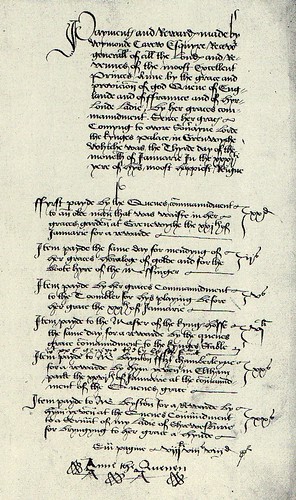
This is a rare document from the very short reign of Anne of Cleves as Queen of England. It carries her signature, Anne the Quenen. Few documents like this has survived due to the shortness of Anne's reign which meant that she simply did not have enough time to use her new powerful signature.
Stay in the Past
Wednesday, 13 February 2013
Remainder of a Short Reign
This is a rare document from the very short reign of Anne of Cleves as Queen of England. It carries her signature, Anne the Quenen. Few documents like this has survived due to the shortness of Anne's reign which meant that she simply did not have enough time to use her new powerful signature.
Seal Purse of Elizabeth I
This seal purse is embroidered with the Great Seal of England and Queen Elizabeth's initials: ER (Elizabeth Regina - Regina being the Latin word for Queen). The Great Seal of Elizabeth was carried in this purse in a procession before the Lord Chancellor and Keeper of the Seal.
Originally, the Seal Purse was a purse of plain white leather but when Elizabeth ascended to the throne, it had developed into an elaborate piece of work - the Tudor rose is embroidered as well.
The Great Seal itself was of extreme importance. It was by this seal that every official document would be marked and if the document did not have the seal on it, it meant that the Queen had not been consulted - and that was a dangerous thing to forget.
It was a tradition that the Lord Chancellor or Keeper of the Great Seal was allowed to keep the Seal Purse when there was no longer any use for it - normally when the monarch in question either died or had another one made. This particular purse was given by Thomas Egerton (Lord Chancellor in 1596) to his servant Henry Jones whose family transformed it into a cushion cover and added the wheat ears at the edge.
Confess!
Archbishop Cranmer tries to get Katherine Howard to confess her guilt and her offences against the King
Drawings of the Queens
The Ugly Truth?
This is an engraving of Henry VIII not longer before he died. When this was made the King was married to Catherine Parr. Does the picture show the truth? If that is the case then Holbein obviously beautified the ageing King in his last portraits of him
The Rose Without a Thorn
Katherine Howard - with her obedient motto - had of course chosen her badge from the nick-name Henry VIII had given her: His rose without a thorn. So, consequently, Katherine's main feature is a rose without a thorn. The rose petals are the united colours of Lancaster and York - another symbol of her obedience towards her husband and his family.
It is a more feminine version of Henry VIII's own badge.
Badge of the German Princess
Anne of Cleves' badge is very different from Henry VIII's previous three wives in colour and form. The escarbuncle (the main feature of her badge) is a symbol sovereignty or a precious gemstone. Her badge was not as packed with symbols as the other Queen's had been - in fact the only unique feature of any meaning other than the escarbuncle, is the colour: gold.
Gold symbolised not only the luxury colour that we associate it with but both generosity and enlightenment. But - as we know - Anne's badge spent a minimum space of time on the walls of the royal palaces.
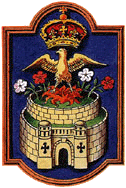
Jane Seymour's Phoenix
Like her predecessors - and successors - Jane Seymour had her own personal badge. The phoenix is not only the symbol of rebirth but also that of love. That Jane added it as the main figure to her badge was probably to show that Henry's love for her was a rebirth from his marriage to Anne - much like Anne Boleyn did before her. The fort represents a safe haven or a home - those exact things that Jane became known for.
Once again the red and white Tudor flowers that spring from the castle alongside the newborn phoenix symbolises the heirs that would spring from the safe home she would provide.
Purkoy - Anne Boleyn's Little Pet
Anne Boleyn had a special fondness for dogs and especially for her little dog whom she named Purkoy, after the French word pourquoi (which means why?). The little puddle had sad ending, though. While Anne Boleyn was imprisoned in the Tower, awaiting her execution, her favourite little pet fell out of a window and died. No one had the heart to tell the condemned woman that her dog had died - and when Anne a few weeks later was executed, she still knew nothing of it.
Perhaps it was there to welcome her in heaven - at least its a nice thought ....
Henry's Medical Paranoia
Henry VIII was extremely paranoid on many different areas and one of them was medicine. He distrusted his doctors and during his reign, he began mixing his own treatments which included a cure for ulcers - probably inspired by the nasty ulcer he had on his leg. The King even used the prescriptions he came up with for himself.
Henry was very afraid of illnesses and every time there was an outbreak of plague, sweating sickness or the like, the King would run away till one of his more secluded castles where he felt safe from the horrible diseases.
Henry had a fear of germs which led to another point that separated the king from the rest of his court: he enjoyed regular bathing and was - unlike his fellow Tudors - convinced that bathing was an effective way of keeping away the germs he feared so much. His fear of diseases where transferred to his son, Edward. When Henry finally had the son he had wished for, the King ordered that the child's apartments should be scrubbed down regularly and the boy himself was to be washed on a daily basis. Perhaps this overly attention to cleanliness combined with a world that did not share his point of view on this point and was notoriously filthy, a part of the reason for why Edward would be so sensitive to influenza later on in life.
Henry VIII's Astronomical Clock
- The hour
- The month
- Day of the month
- The position of the sun in the ecliptic
- The twelve signs of the zodiac
- The number of days that have elapsed since the beginning of the year
- The phases of the moon
- It's age in days
- The hour in which it crosses the meridian which means that it tells the time of high time in London
Since Henry VIII often used to travel by barge to Hampton Court Palace it was practical to know when it was high tide and thereby the best time to travel by.
The earth is centred in the middle of the clock because the clock was made before Copernicus and Galileo began to doubt the heliocentric world-image (where the sun is the centre of the universe). The minor circle is the sun that was said to circle around the earth at the time.
Elizabeth I
The Greatest Queen of England - the Queen who refused to surrender her crown and submit to a man
Through her childhood she was taken care of by three different women in turn: Lady Bryant (who was transferred to her brother's establishment), Lady Troy (who retired between 1545-16) and finally Lady Catherine Ashley (who remained Elizabeth's friend till her death). Elizabeth was a very intelligent child and she soon learned French, Flemish, Spanish, Italian and was able to write Latin, English and Italian.
Mary I
Bloody Mary - a neglected Princess who became a feared Queen
But her father's doting soon turned into disappointment when it turned out that there would come no sons from the marriage to Catherine of Aragon - until then it had always been expected that Mary would have a brother to take over the kingdom. Mary was sent to Wales in 1525 by her father where she was to reign over the Council of Wales and the Marches, though it can be assumed that she only ruled in name. The young princess was given an establishment that took after a court at Ludlow Castle and had some of the prerogatives that normally belonged to the Prince of Wales. She spent three years at the Marches until she returned to the counties outside London in 1528.
Tuesday, 12 February 2013
A Generous Queen
My first titillating titbit is about Anne Boleyn:
Anne Boleyn gave more money to the poor of England in her three years as Queen than her predecessor Catherine of Aragon did during her nearly 20 years as Queen. When Thomas Cromwell wanted to transfer the money that came out of the dissolutions of the monasteries to the King's treasury, Anne protested and wanted the money to go to the poor. When on her summer progress in 1535 she spent more time than her husband, Henry VIII, inquiring after how she could help the people.
It puts a more human perspective to the image that has been painted of Anne as a selfish woman.
Hair of a Tudor
The hair in the locket to the left belongs to Mary Tudor, who was Queen of France for a short while. Born as a Tudor, Mary was the daughter of Henry VII and Elizabeth of York - consequently making her the sister of Henry VIII and Arthur. The hair is the notorious Tudor-red that is said to have been a trademark of the Tudors - both Henry VIII and Elizabeth I were famous for their copper-red hair.
The hair was taken from Mary's tomb in 1784 on September 6th when her tomb at St. Edmundsbury was opened for the first time ever since it was interred after Mary's death.
Wolsey's Portable Sundial
It is a bit difficult to see what that golden thing to the left actually is and when it was made it was quite a marvel as well. It is a portable sundial that belonged to Cardinal Wolsey. The symbol of the Bishop of York and Wolsey's "Cardinal" symbol is engraved on the sundial.
At the time of its creation, technology was fascinating and many people were very interested in every science imaginable. It can only be imagined that the sundial is such an object that Henry VIII would have confiscated when Wolsey fell from power and the King confiscated the Cardinal's belongings.
In the shadow of the crown
This book by Jean Plaidy tells the story of Mary I and her way to the throne - a way where she had to go through almost all sorrows imaginable.
The Last Boleyn
This book focuses on Mary Boleyn who was the last Tudor after the execution of her sister and brother (Anne and George) and the consequent death of both her parents - she was also the Boleyn who ended up defying the rules and marrying out of love.
Death of Henry VII
This drawing show the death of Henry VII (on the bed) and his most intimate friends and courtiers (clockwise):
Richard Fox - Bishop of Winchester
George - Lord Hastings
Richard Weston - Esquire of the body and Groom of the Privy Chamber
Richard Clement - Groom of the Privy Chamber
Matthew Baker - Esquire of the body
John Sharpe and William Tyler - Gentlemen Ushers
Hugh Denis - Esquire of the body
William Fitzwilliam - Gentleman usher (holds the staff)
The other people present are two clerics and three doctors (holding urine bottles). Since the King was out of the public's eye it was possible to keep the King's death a secret up until the 24th April.
Subscribe to:
Posts (Atom)